"It shows what Blackwell’s called “the exacting nature” of Tolkien’s creative vision: he corrects place names, provides extra ones, and gives Baynes a host of suggestions about the map’s various flora and fauna."
You've got to respect the man for his attention to detail. To the outsider it might seem as if it were near insanity levels (fully creating multiple language families for instance https://en.wikipedia.org/wiki/Languages_constructed_by_J._R....). But you feel the histories and mythology behind the languages in the works. There's just an amazing vitality and realism in his universe that I've personally never felt in another work of fantasy as good as those other books might be.
I read a biography about him many years ago, and if I remember correctly he wrote the stories for the languages not the other way around, since he discovered that his languages needed a mythology and history in order to be realistic.
> You've got to respect the man for his attention to detail (...) fully creating multiple language families for instance
These things are related, but in the exact opposite way from what you're suggesting.
Tolkien was, first and foremost, a linguist. Language was his passion, and he was of the opinion that, e.g., Esperanto was much more of a dead language than Latin or Ancient Greek are, because Esperanto doesn't have a culture to call its own, whereas Latin and Ancient Greek have a wealth of culture attached to them, and, therefore, a life of their own.
Elvish and dwarfish weren't invented to give Middle Earth more detail. Middle Earth was invented so that the languages would be, in a sense, alive.
At least that's what he said. The Hobbit for example would / could have been told without the languages, and was at first independent of the Middle Earth.
Relevant quote: "All this only as background to the stories, though languages and names are for me inextricable from the stories. They are and were so to speak an attempt to give a background or a world in which my expressions of linguistic taste could have a function. The stories were comparatively late in coming." From letter 163.
The Dwarf Fortress guys remind me of this kind of obsession. Not that both have to do with dwarves, but that both need a world for their obsession to live in. The DF guys created a world for their incredibly detailed simulations, while Tolkein invented a world for his languages.
They're basically making Tolkien-the-software. I'm sure they consider the current language system to be just a placeholder for when they have the code to generate and mutate/mix grammars, phonology and vocabulary based on details of what happens to civilizations during the generated history.
On the other hand, Tolkien had no clue about geology. If you think about how rivers flow from mountains to oceans, the map of Middleearth is unrealistic. Anduin heads straight towards hills and mountains (Emyn Muil and Osgiliath)? In the north west, Luhn/Lune flows south to the Grey Havens instead of the short way to the northern ocean? The sea of Rhun and Nurnen are both dead (no outflow)?
(disclaimer: I still love and respect Tolkiens work! Especially the Silmarillion.)
You do get situations where rivers cut through mountain ranges - it can happen when the river existed before the mountain range and as the mountains were pushed up the river continued to cut it's way through:
I studied geology and none of the river paths in the LOTR map seem particularly unrealistic. Tolkien's map shows local elevation but not absolute elevation, which, when it comes to a river's path, matters more than people think.
For example, the plain between the Misty Mountains and Mirkwood could be like the plain in front of the Colorado front range: dead flat, but still at 5,000+ feet in elevation. That would give it plenty of vertical drop to the sea. It's certainly possible that the absolute elevation of the Anduin at the ford at Carrock is similar to the summit of the mountain behind Minas Tirith!
And it takes doesn't take much elevation drop to make a river flow. The Lune would work as drawn if there were cliffs or hills only a couple of hundred feet high on the southern edge of the Bay of Forochel, which could happen with glaciation--and it is known as the bay of ice in the books.
> creating multiple language families for instance
I remember reading in one of the introductions that he enjoyed working on the languages for their own sake, and would work on that if he didn't feel like working on the story. It's not as though everything he did was at this level of detail -- architecture, technology, biology, it all varies in how much work he put into filling it out. But the languages were a passion for him.
I don't think it's so much that he created the languages in service to the world and the story as that it's a core piece of the expression. I think of the series as a work of hard linguistic fiction (by analogy with hard science fiction), and seen in that light, written by a professional in the field, it really doesn't seem crazy at all that they're as developed as they are.
I found Shippey's "J.R.R. Tolkien: Author of the Century" a compelling read. It examines Tolkien's fascination with myth (which, I suppose, is effectively redundant; can't very well write a biography of him without it).
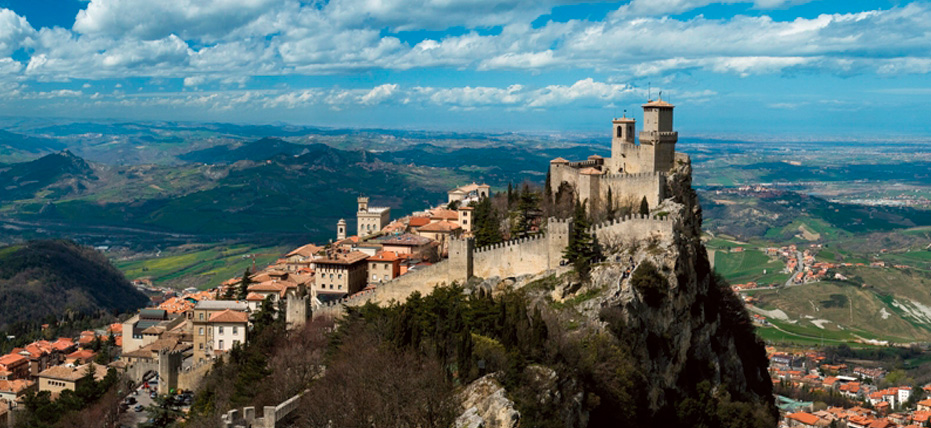
"The novelist also uses Belgrade, Cyprus, and Jerusalem as other reference points, and according to Blackwell’s suggests that “the city of Ravenna is the inspiration behind Minas Tirith - a key location in the third book of the Lord of The Rings trilogy”."
Fun fact: Belgrade (Београд), capital of Serbia, literary means "the white city" in Serbian.
Ravenna is where the Western Roman capital moved to (402-476) in an effort to be more easily defended; likewise the capital of Gondor was moved from Osgiliath to Minas Tirith to more easily defend it.
Wouldn't have made much of a difference as Odoacer simply bypassed Ravenna (and would have bypassed San Marino) on his way to sacking Rome. Rome at that time had fallen far from grace, but the sacking was the nail on the coffin.
The true strength of Rome had already left, gone east to Constantinople. 4th/5th century western Rome was just a slow and painful decay. The East survived until 1453.
Fun little fact: the Roman Empire existed until 1453 and was finally destroyed by the Ottomans; the Ottomans existed until the end of WW1; the Cubbies last won the world series in 1908; which all means: the last time the Cubs won the world series, the empire that destroyed the Roman empire was still around.
I can't recall a sack of Rome by Odoacer, nor can I find after a quick search, but my memory may be lasping here.
FWIW, Odoacer did escape to Ravenna to escape Theoderic and the siege lasted circa 3 years, so it did prove to be a reasonable location from that point of view.
Which was the point - Rome was too easy to attack, so the government moved to Ravenna so that when it happened, at least the emperor and bureaucracy wouldn't be at risk.
Trouble is, there was no San Marino at the time.
While I have no idea whether or not this was the inspiration for Tolkien, some element sort of match, from the capital being moved to the following reconquest of Ravenna under Byzantine rule, and also the presence of marshes to the north of the city (if Middle Earth map is oriented North-top South-bottom, which I'm not sure).


You've got to respect the man for his attention to detail. To the outsider it might seem as if it were near insanity levels (fully creating multiple language families for instance https://en.wikipedia.org/wiki/Languages_constructed_by_J._R....). But you feel the histories and mythology behind the languages in the works. There's just an amazing vitality and realism in his universe that I've personally never felt in another work of fantasy as good as those other books might be.
I read a biography about him many years ago, and if I remember correctly he wrote the stories for the languages not the other way around, since he discovered that his languages needed a mythology and history in order to be realistic.