This is sometimes called "beach replenishment". It's popular with owners of beach front houses, but the cost-effectiveness of moving all that sand is questioned.[1]
There's an amusing case on this. If the U.S. Government widens a beach by adding sand, is the new land public property? The U.S. Supreme Court said yes, much to the annoyance of some beachfront property owners.[2] If you want to extend your own beach, buy your own sand.
The country of the Netherlands just about owes its current existence to the practice of beach nourishment. In a lot of cases it is the most economical and least impactfull way to defend an eroding sandy coast. So called hard solutions (rock and conrete based) mostly fail within a few years/decades. And what is the point of living along the coast if there is no beach anyways?
Note that it is well understood that beach nourishment is a recurring thing, and thus will be planned/budgetted for. Any other kind of coastal defence structure will also need (a lot of) maintenance which is oftentimes neglected, leading to catastrophic failure (sudden collapse/breach). A sandy coast can certainly fail to provide adequate protection, but it is rarely sudden breach/collapse/rupture.
The article notes that this is the first time this kind of thing has been done in the UK. And indeed, the Netherlands has been doing it since about a decade: https://en.wikipedia.org/wiki/Sand_engine (also mentions the Bacton gas terminal, as in the article).
Germany has been doing it for its North Frisian islands sind 1972. The key words: has been doing. It works, but in most cases the sea keeps taking away the sand and you keep having to put it back.
I had the same question and I’m also not sure why this is getting downvoted. I’ve never seen water referred to that way even in scientific contexts. Is it supposed to be a joke?
It moves along the coast mostly, until it is either blocked by e.g. a port entrance breakwater or in a shallow estuary, or it is washed up to shore and gets blown into the dunes
Key point for me was "It’s not a permanent solution, however - the sand is expected to last for about 15 years." It doesn't say whether the full £20m spend will be needed every 15 years though, but it sounds like it just buys more time to move the critical infrastructure further inland.
Really interesting! It's common to see s/groins/groynes/[0] installed on many UK beaches, which helps when the shore is also small rock/pebble. But this seems more dynamic and natural, I hope it works in the long term!
Yeah, that was my first thought too. I was actually pretty excited by the title, I thought this would be about olivine beaches. Pretty disappointed when I read the article.
Cubic tonnes are technically a real and valid (SI even, ish) unit of measurement (for example the fundamental evaporation rate of a black hole via hawking radiation is on the order of 100 million cubic tonnes per second), but I think in this case they're just outright wrong.
The time it takes a black hole to evaporate is proportional to the cube of its mass. If you graph mass-cubed versus time, it decreases linearly at about 100 million cubic tonnes per second. The actual mass decreases at a rate that's inversely proportional to the square of the mass.
Interestingly this may be a typo as the article mentions cubic meters.
But wiki says cubic tons is a measure of volume that is obsolete in UK and mostly used in the US
If you're going to be pedantic, please put in more effort in identifying the correct unit of measurement, whether it's feet, meters, leagues, or terameters.
A terameter is a unit of length equal to 1 trillion meters.
A cubic terameter is 1x10^36 cubic meters.
2 million cubic meters would be something like:
.000000000000000000000000000002 cubic terameters
Or:
2e-30 terameter³
If you're wanting minimalconversion, the amount comes to 2 cubic hectometers.
Indeed. 2 million tonnes == 2Tg. 2 million metre³ == 2hm³. The unit in the article is "cubic tonne". I mixed the whole thing without thinking. This is maybe adding weight (what a pun) to my original point though. Using the proper unit at the source.
No matter how you parse it, it cannot be 2Tm³. The most generous reading would be "two trillion cubic metres" rather than two million. It could also be read to mean that you want to cube a terametre.
This is a newer technology, intended to replace the once-every-few-years suppletions with one that only needs to be done every 20 years or so, thus causing less overall impact on the environment. The already existing one before the coast of South Holland was evaluated fairly recently, and it looks like it will last even longer than designed.
Basically they dump a lot more sand in a strategic location and shape so that, if I understand correctly, the sea will make it flow to where it is wanted. https://en.wikipedia.org/wiki/Sand_engine
Yes, but in free markets. They are both dirty fuels, so this shouldn't be a free market decision. This is something we have to do collectively that the market participants won't choose to do on their own.


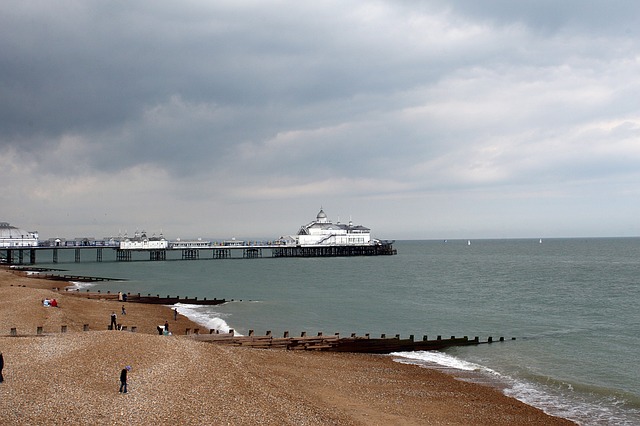
There's an amusing case on this. If the U.S. Government widens a beach by adding sand, is the new land public property? The U.S. Supreme Court said yes, much to the annoyance of some beachfront property owners.[2] If you want to extend your own beach, buy your own sand.
[1] https://granthshala.com/jersey-shore-beach-widening-is-a-was...
[2] http://www.cnn.com/2010/CRIME/06/17/scotus.property/index.ht...