Well, maybe, but think of the flip side of this. I've worked very hard to earn X amount of dollars, however the monetary policies of banks around the world have pushed inflation up, essentially eating up my savings, all the while pushing the interest rate on deposits to zero and below. I would like to not lose the purchasing power that I've earned, so my only choice is to invest in something. I also want to invest in something as low risk as possible; if my hand wasn't forced, I'd be happy to keep my money at the bank at 2%.
Right now, investing in public companies and tech is very risky, as valuations are at record highs. Many experts estimate near-zero returns for decades from public markets. And, as a small-time investor, I don't have access to private deals or markets.
So, that leaves real estate. I don't put my money there because I want to drive up the cost of shelter for anyone, I do it because I don't have any other reasonable way to protect my savings.
> Right now, investing in public companies and tech is very risky, as valuations are at record highs. Many experts estimate near-zero returns for decades from public markets. And, as a small-time investor, I don't have access to private deals or markets.
> So, that leaves real estate.
That’s a huge leap to jump to real estate as somehow safer than public market investing. Real Estate can also be highly volatile and is also prone to significant drawdowns.
Real Estate also has very high carrying costs relative to other investments. Especially if you’re trying to rent it out, at which point it becomes a business with not insignificant labor requirements, either from you or someone you hire. It’s more of a side job than an investment.
If you’re serious about investing, you shouldn’t be choosing between a bank account or real estate. Those are on opposite ends of the risk spectrum and opposite ends of the work-required spectrum.
Instead, you’d want to do things like dollar cost averaging into equities over time (nobody really invests by keeping it all in cash and then flipping it all into specific stocks in the middle of a frothy market). Or you should be looking into ladder if CDs, or bonds, or something like I-bonds to invest an asset specifically indexed to inflation.
But choosing between a 0% bank account or real estate investing is a major false dichotomy.
>But choosing between a 0% bank account or real estate investing is a major false dichotomy.
Ok, so interest rates are near zero. A ton of money is leaving the bond market and going to stocks. Price of stocks is being pushed up due to the increase in money chasing yield there. These companies didn't get more valuable, your earnings per share just went down. Now you're anticipating inflation as printing money is a great way to get out of the next crisis when your interest rate can't get any lower. This personally leads me to real estate.
Not sure if this is what the parent was talking about, but the risk equation changes significantly for real estate that you own to live in it, both because of government incentives and because you can always derive value from the asset through living in it, regardless of what happens to the resale value.
not to dispute your point, because it makes sense from the individual's perspective, but this...
> Right now, investing in public companies and tech is very risky, as valuations are at record highs. Many experts estimate near-zero returns for decades from public markets.
...is a big red arrow pointing to the fact that we're living in a castle made of sand
if we continue to let pathological incentives drive economic decisions the tide will wipe it all away
purchasing power is a mutually constructed fiction and remains a useful social technology only while material productivity can plausibly support the web of lies we tell each other
now that people have noticed the foundation caving in, it would be nice if we could formulate and incentivize a positive sum response, otherwise we get zero or negative sum dogfights over scraps as you describe
The difference is the USD is the global reserve currency. And that’s not changing anytime soon. It’s a totally different game when the entire planet wants to (or has to) transact in your money.
It’s also justified as the USA is by far the most dynamic economy in the world and has the most advanced military there to protect your investment in USD.
Such an overblown and baseless talking point. The USA has never been in a stronger position. Literally just printed 40% more money than has ever been created and the demand for her bonds is insatiable.
I’m happy for China and Chinese people having a better quality of life. But their economy is based on humans doing things inexpensive. It’s essentially a services business, not a SaaS business. It doesn’t scale well but they have so many poor people to exploit that they can make a thing of it.
When the seriously export culture, novel technology, or medicines then sure. When they aren’t a net importer of food then sure. But the yuan is not a serious threat to usd. It’s pegged to it.
Behind the cheap workers is whole industries and ecosystems and know-how, it's not a cheap labor problem. Bangladesh is cheap labor but if you wanted to start building phones there you will not have the ecosystem to support you..
This analysis frames the problem as though it’s concurrent with current inflation rates.
The problem goes back for much longer though. Interest rates hav been near zero since the Great Recession, and for most of that period, inflation was also below 2% almost the entire time. Add to that a lot of the year over year inflation we are experiencing is due to base effects eg the collapse of oil prices last year. Current oil prices are hardly elevated from their historical norms.
You’re trying to store purchasing power as structural macro economic and demographic changes occur. This is challenging, at best. Look to Japan for what the future holds.
Not every country is, or ever will be, like Japan. I would say most of them won't during our lives.
I agree with OP, if you just leave hard earned money of us middle class sit in the bank, it will be eaten away by inflation and fees. Its what our parents did, and its properly dumb. Risk with markets which most don't understand, or invest into real estate which everybody does at least a bit. Most folks consider only these 2 options.
Also, if SHTF, in most cases you will have physical places or even land to live off, instead of few bank statements. People will still have to live somewhere, and there is constantly more of us.
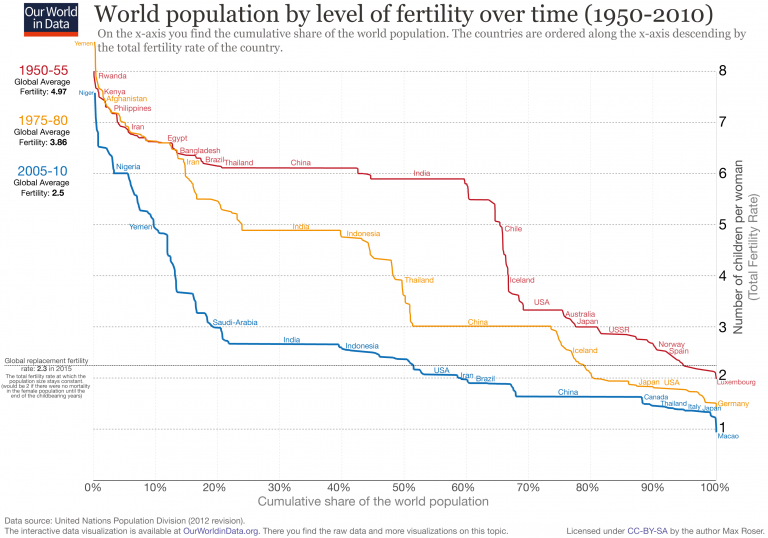
All countries eventually end up as Japan. India and Africa will race to be last. China is already somewhere between 1.1 and 1.3 total fertility rate. Sustained sub replacement rates (<2.1 fertility rate) locks in population momentum.
This is important because age of labor and consumers directly influences macro economic conditions, which trickles down to investment returns.
The end of history has not been reached. Just because we haven't seen it yet doesn't mean fertility trends won't reverse in certain places at some point. Governments have by no means exhausted their means to effect such a change, for example.
On the world scale maybe, but the USA is still one of the most desirable places to immigrate to. So while some countries will be abandoned, the US can just increase immigration which creates the necessary future demand for assets.
I agree with your point about systemic issues pushing people towards real estate or to carry cheap debt (particularly in the form of mortgages). But the leap from:
> investing in public companies and tech is very risky, as valuations are at record highs
To real estate where valuations are also insanity and at record highs doesn't make any sense.
> investing in public companies and tech is very risky, as valuations are at record highs
> To real estate where valuations are also insanity and at record highs doesn't make any sense.
The difference for me is that I saw what was happening in public markets and I bought real estate in a country where this wasn't yet the case. It is now though, so your point is valid.


Right now, investing in public companies and tech is very risky, as valuations are at record highs. Many experts estimate near-zero returns for decades from public markets. And, as a small-time investor, I don't have access to private deals or markets.
So, that leaves real estate. I don't put my money there because I want to drive up the cost of shelter for anyone, I do it because I don't have any other reasonable way to protect my savings.