Fun fact: Historically, these air screws came from China and were sold as child toys on markets in Venice as early as in the 1200s. (This is probably also, where DaVinci picked up the idea.)
The embedded fun fact here is that by the 13th century China was already exporting small goods like children's toys to Europe! til my knowledge of trade doesn't go any deeper or further back than "Marco Polo traded some things some time ago".
It's amazing how a shallow knowledge of history can make these sorts of things seem so impossible for some reason. People definitely knew way more than I'd given them credit for.
I think there was a lot more trading than we usually think. It was an industry to trade for some states, and at one point in Europe they wanted to start trading directly, independent of political going-ons in the middle east. Starting the voyages of discovery.
They had deep enough trade links that some refugee sassanid princes ended up being absorbed into the chinese nobility after the muslim consquest of persia.
> that by the 13th century China was already exporting small goods
Marco Polo lived from the mid-13th to early-14th centuries. Chinese merchants were trading with the West from at least the date of the founding of Rome, and likely earlier, 800-750BC. Greeks were traveling to China by 230BC, and the Han Dynasty officially opened trade with the West utilizing Silk Road routes by 130BC.
From presentation at 9th Annual Electric VTOL Symposium [0]: Revolutionary Flight Vehicle Based on Leonardo da Vinci Aerial Screw: A Paradigm Shift in VTOL Technology Austin Prete, Vengalattore Nagaraj, Inderjit Chopra, Univ. of Maryland
The team is from Alfred Gessow Rotorcraft Center Department of Aerospace Engineering University of Maryland. The PDF below [1] is very detailed and comes from a design competition there [2].
I don't think this is true. Archimedes screw is a similarly shaped helix but contained or partially contained in a tube so that it can move substances by rotary action.
Using a helix as a simple machine is an old concept and probably predates writing; that's about as much of a common ancestor as they share.
From the way you worded this, I was expecting them to use the chair and sleigh as propellers. What's special about OP is that the propeller design is unusual, proving that Leonardo wasn't that far off when he came up with the idea.
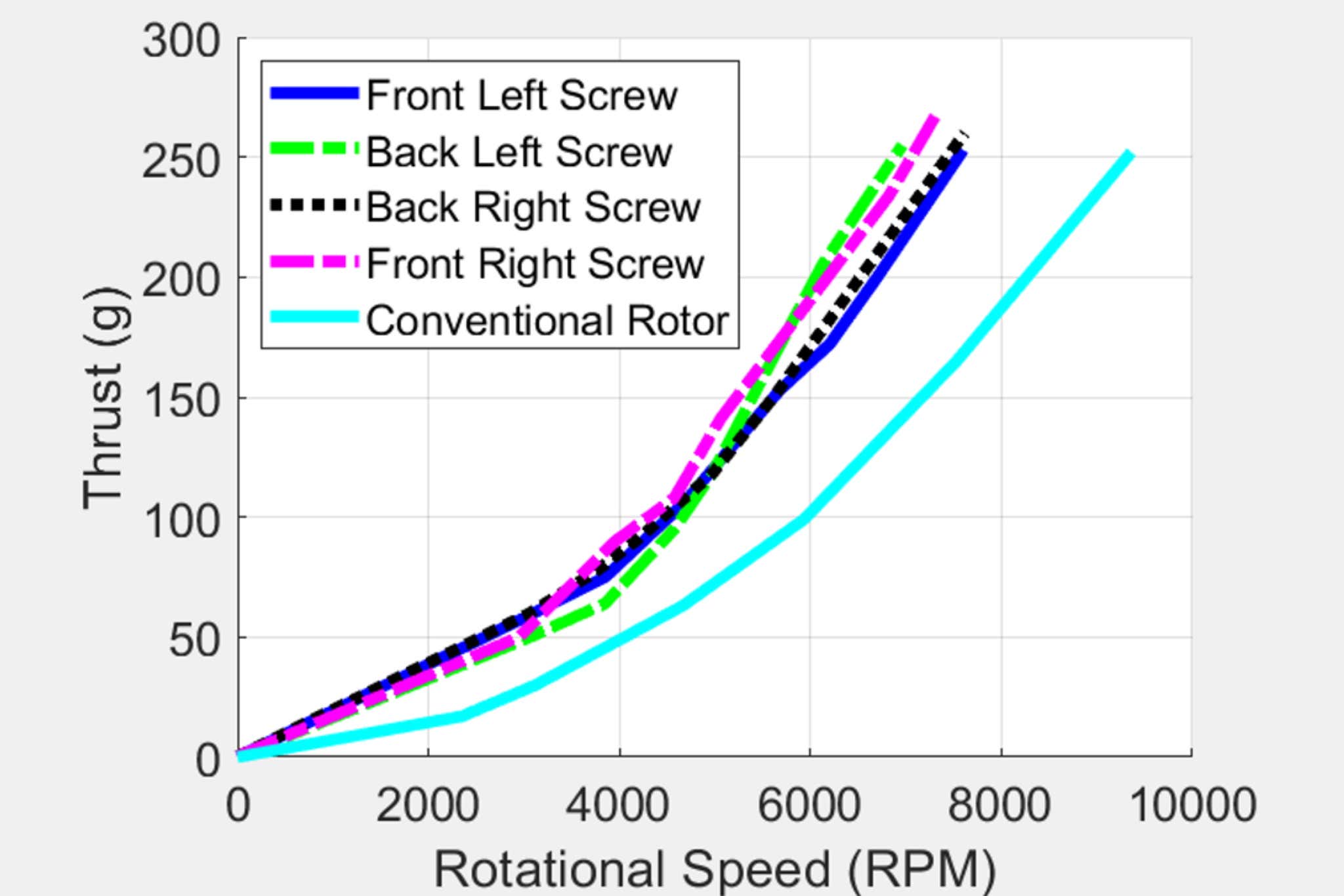
Although a better metric might be to look at the thrust to motor power and get an idea of its efficiency relative to traditional rotors. I can put larger blades on the motor and will get more thrust at the same RPM but the motors will have to work harder to push those blades.
Indeed, the screw shape is essentially a large number of rotor blades, welded leading edge to trailing edge. Undoubtedly it produces more thrust for a given RPM, and undoubtedly the efficiency is horrifically bad.
Is the efficiency the number of amps required to gain/maintain a particular rotational speed? So given rotational speed 4k conventional is 50g thrust and DaVinci 75ish g, if conventional costs 10amp then DaVinci would be less efficient if it uses more than 15 amps?
>Is the efficiency the number of amps required to gain/maintain a particular rotational speed?
Thrust, not RPM. Efficiency for any actuator is defined by (work done)/(power in). You could replace the Archimedes screw with a simple axle, and it would be much easier to maintain RPM - however it would move no air no matter how much power you dumped into it, and so would have 0% efficiency.
> So given rotational speed 4k conventional is 50g thrust and DaVinci 75ish g, if conventional costs 10amp then DaVinci would be less efficient if it uses more than 15 amps?
Not quite. Thrust / power for disk-shaped actuators is not a constant ratio, but a curve - an x^(3/2) power law, to be exact. You need exponentially more power to maintain a linear increase in thrust. So while it's correct that thrust/amps[note] describes the efficiency, it's not fair to compare conventional at 50g and DaVinci at 75g.
However I guarantee you if you put the same power into this rotor, you'll get less thrust than if you put it into a regular prop.
[note] Watts, really, but same thing if voltage is held constant
You would likely be interested in pages 5,6 of the paper/proposal. It looks like the "Figure of Merit" (FM) is used to "compare efficiency and performance of aerial screws to conventional rotors." If I read the graphs on page 6 correctly the screw gets in the range of 5-30% of the efficiency of a conventional rotor.
Yep. Traditionally, drones use 2-3 bladed props, each additional prop blade increases thrust per rpm, but increases load by significantly more, hurting actual thrust per watt.
I’d expect a screw to be the degenerate case and probably worse than a conventional many-bladed prop.
In my imagination: Don't rotor blades also profit from air getting "in between" them, so that they have something to push against and thus push upwards? The screw relies on air getting in from the sides, while that air is being pushes outwards by the rotating screw.
The authors did test having a "lip" around the edge of the screw:
It was hypothesized that a down facing lip would prevent air from escaping radially outward from the rotor, but this was proven incorrect. All rotors tested (3,4 and 5 in Figure 2.2) have 1 turn, a pitch of 100 mm (3.94 in), a radius of 76 mm (3 in), and a 1:1 taper ratio.
A downward facing lip showed reduced thrust and an upward facing lip showed negligible impact on thrust in Figure 2.7.
Flow visualization conducted during this trial revealed that air was being ingested radially inward during operation of the no lip and up facing lip aerial screws, and that this flow was disrupted by the down facing lip. These results support the findings of the CFD studies detailed in Chapter 3.
Figure 2.8 indicates that the presence of a lip in either direction increased the power requirement of the rotor. Figure 2.9 shows that the presence of a lip in either direction also reduced the FM of the aerial screw. Therefore, a lip is not a useful design feature at all, and was discarded.
>It would be interesting to understand why load increases more quickly than thrust for increasing blade counts.
The key to this is that, for both ducted fans and props, a larger swept area is more efficient, while # of blades simply changes the torque/rpm ratio with negligible effect on efficiency. Thus, for a given torque, it's always better to drive two longer blades, than 3 shorter ones.
If you enjoy looking at pictures of WW2 fighters, you'll notice that the early planes had 2 bladed props, the midwar ones had 3 bladed props, and right at the end they jump to 4 and 5 blades - the reason being that the better engines got, the more torque they had to dissipate, and you can only make a propeller so big before you hit ground clearance problems. Helicopters, on the other hand, can make their rotors as large as they like - and so they do, and typically only have 2 blades. Only on helicopters like the Chinook, where they made the blades as long as they could feasibly engineer and still had torque to spare, do you see 3.
> Do ducted fans have similar changes in load-to-thrust ratio given an increase in blade count?
Not really. The parameter that describes how many blades are in a ducted fan is known as "solidity", and while it does have minor implications for blade shape the general efficiency is excellent no matter what. It's actually surprisingly insensitive - you can take a ducted fan designed with a 5 bladed rotor and just slap a 7 bladed rotor in there instead, without even redesigning the blades, and provided the power source is equally efficient at a somewhat lower RPM you basically won't be able to measure any difference in performance at all. Ducted fans can turn shaft power into air momentum with about 90% efficiency.
The reason that large swept areas are more efficient than small ones is simple physics and geometry. Energy (the thing you put in) is 1/2 mv^2, while momentum (the thing you get out) is simply mv. So for best efficiency you want to keep v as low as possible. It's better to get your momentum by moving a lot of air slowly, than a little air quickly.
I thought the exact same thing. Clicked the link fully expecting to see chairs spinning at 7000 rpm. Was actually wondering if these objects could handle the forces involved without disintegrating.
But they're using traditional blades so obviously it can lift anything. Isn't the whole point of the original article that the motors work with DaVinci's screw rotor design, generating lift?
I don’t understand why so many people find it difficult to imagine ancient people understanding something as finite as aerodynamic mathematics. Their understanding of all other maths was phenomenal. Newton didn’t invent Newtonian physics and he probably wasn’t even as savvy as some of the ancients were. There is far too much inductive reasoning in history and historically science.
No, but the real point is that the power to weight ratios of hobby BLDCs have absolutely gone crazy over the past 2 decades. Lots of work put into their power efficiency to maximize flight time on batteries.
Does anyone know how old the toys that launched a propeller from a stick-spiral are? I used to play around with these as a kid, and was fascinated how low tech they could be and still fly.
Edit:
This Chinese helicopter toy was introduced into Europe and "made its earliest appearances in Renaissance European paintings and in the drawings of Leonardo da Vinci."
Wright brothers were also quoted saying that they can make this table fly (the table where the interview was taking place at) if they could have a powerful enough motor at hand. This was, of course, after the first man flight was achieved.
That's the great span thing going on there. The house where my parents live has always been in my family had as its original residents my father, my aunt, my grandmother and my great-great-grandmother (yes, that's the number of correct greats there). The last of these was born before the establishment of the Austro-Hungarian empire in what's now the Czech Republic and was at the time the Austrian Empire. Family history in the old country is a bit murky so I don't have any dates for her ancestors, but she would have known people who lived under the Holy Roman Empire.
Sure, but with a toy that simple I would expect it to be a lot older than just a century. But I guess it may be a cultural context thing: in my country some houses were built before Europeans even set foot in North America and the city I grew up in was literally founded by the Romans.
Given how simple the toy is, I wouldn't be surprised to find out it dates back 500 or even 5000 years or more, even if it had to be re-invented several times in between.
Just a stick with a 2-blade prop on the end. You spin the stick between your hands and see how high it'll go. But that got boring real quick! The real fun was trying to shred your friends' faces with it at 10 paces away.