That's a state institution, and only 17% of state prisoners are there for a drug offenses. 83% of those dots are in for something else.
There is some sort of weird need for certain groups of people to ascribe all crime to the drug war. I assume its a result of their holding worldviews incompatible with the fact that the world has lots of bad, antisocial, people.
> That's a state institution, and only 17% of state prisoners are there for a drug offense.
That doesn't mean that only 17% are there because of the drug war.
> There is some sort of weird need for certain groups of people to pretend that crime only happens because of the drug war.
Perhaps, but that's no more weird than the weird need for certain groups of people to minimize the impact of the drug war, e.g., by pretending that the only people who are imprison because of the drug war are those convicted of drug offenses. Prosecutions conducted as part of the war on drugs aren't all "drug offenses" any more than prosecutions conducted as part of Prohibition were all liquor offenses.
I hope you're being snarky, because it's well documented and should be completely obvious. Whenever you have a black market economy where product is sold for large multiples of its production costs, it will inevitably be accompanied by violence. And when substances are expensive and addictive, people will steal to support their addictions. And when kids grow up without parents, either because they're in jail, addicts unfit to parent or dead from drug-related violence, they're much more likely to run afoul of the law as adults.
There's a ton of reasons why someone would be in jail for a reason related to the WoD without their crime being classified as a drug offense.
I really doubt a majority of prisoners are in there for black market violence. And you can't blame addiction problems on the drug war, there would be just as many addicts if not more without it.
> And you can't blame addiction problems on the drug war, there would be just as many addicts if not more without it.
You can't blame addiction problems on the drug war any more than you can prevent them with a drug war. They're inevitable. But you can treat them as what they truly are, medical problems, rather than criminal acts. You need look no further than the two major legal drugs in our society to see how how few people are stealing or committing acts of violence to support their alcohol or tobacco addictions. But if you rewind 90ish years, you'll see the same violence you see now with illegal drugs surrounding the then-illegal alcohol. We can thank congress for giving us the 18th and 21st amendments because that period showed us the difference between a legal, regulated market for drugs and a black market.
People are going to use drugs whether they're illegal or not. And that means other people will sell them those drugs, no matter what laws we put in place. Faced with that eventuality, we need to structure society to minimize the damage that's caused by this. Criminalizing substances manifestly does not meet this goal. It's asinine to suggest that it hasn't multiplied our prison population many times over.
A fair amount of crime which is not narrowly "drug crime" is at least partially ascribable to the drug war. In decreasing order of being "drug caused," we have:
1. Violence over territory from drug dealers can lead to various violence-related charges.
2. Drug addicts may commit monetary crimes in order to pay for drugs.
3. The general mess that the black market drug trade makes of some neighborhoods creates an environment in which young people feel they have few legitimate options and turn to crime.
Which isn't of course to say that all crime is ascribable to the drug war. But certainly it's more crime than what you'd narrowly call "drug offenses" like possession, dealing, trafficking, or laundering the proceeds.
Also consider that some imprisonment may be attributable to the drug war even if the crime itself is not. Crime does not inevitably lead to imprisonment, or even prosecution -- whether a crime leads to prosecution, and what kind of punishment is sought, doesn't just depend on the crime itself, or whether the prosecutor can prove it, but also on what effect the prosecutor wants to have on the potential target of prosecution.
If someone is a target of law enforcement because of the drug war, but the crime they can make stick is something other than drug-related that they wouldn't have bothered to prosecute in otherwise similar circumstances were it not for the attention given that target in the drug war, they aren't always going to say "oh well, let's not prosecute until we can gather sufficient evidence of a drug offense."
I think the opposite situation is more common, in fact. Drug offenses are easy to prove and invoke federal jurisdiction. That makes it more likely for someone to be prosecuted and incarcerated on a drug offense when in reality they were of interest to the police for other reasons.
I think the kinds of people who engage in gang violence or monetary crimes over drugs fit into the category of "bad, antisocial" people I mentioned. Society would have to deal with their proclivities whether or not their energies were directed towards illegal drugs or something else.
That's quite an amazingly strong claim of biological essentialism. Got any data to back it up?
It would be naive to imagine that there is no "fundamental nature" element to people. That your genes or early childhood experiences or whatever do not make some people more prone to antisocial behavior, and indeed do not make some people guaranteed to be extremely antisocial. Some people who are now criminals connected with the drug trade would, in a counter-factual world of legalized drugs, find other outlets for their antisocial tendencies.
But it's just as naive, perhaps more so, to imagine that the circumstances that people find themselves in do not also affect their social/antisocial behavior. A hundred and sixty years ago, millions of people in the United States actively participated in a monstrous crime perpetrated against an entire race of people, the equivalent of what in the modern world would be multiple felonies per day across their lifetimes. It was certainly antisocial. Was that destiny? Were all those people just inherently bad? If so, what happened to them? Why doesn't modern Georgia have most whites being serial felons?
There is something very important missing in your "nature vs. nurture" worldview, which is: people can and do think for themselves and thereby determine their own values.
For instance, you attribute the grandparent's point of view to "biological essentialism." The grandparent said no such thing. He said: certain people are prone to crime. That is true. Those people are acting out their values and their ideas about the world and about how they can best survive and cope within it. I don't agree that everyone who is a drug criminal would necessarily find some other avenue of crime, but to suggest that they would is not a claim to biological essentialism.
> A hundred and sixty years ago, millions of people in the United States actively participated in a monstrous crime perpetrated against an entire race of people, the equivalent of what in the modern world would be multiple felonies per day across their lifetimes. It was certainly antisocial. Was that destiny? Were all those people just inherently bad? If so, what happened to them? Why doesn't modern Georgia have most whites being serial felons?
What happened is the spread of ideas about human rights from the Enlightenment. Slavery has been the norm for 99% of human history. The Southerners you talked about just didn't have the great newfangled idea of people having rights. That was a real intellectual achievement that took humans thousands of years.
I'm not suggesting anything is biological. But the guy who has never had a real job other than crime isn't not a "bad, antisocial person" just because you can ascribe his condition to his circumstances growing up. Nor can you say that the drug war created those circumstances.[1] The drug war didn't create these insular low-income communities that don't trust the police. It didn't create households where fathers abandon their kids. It didn't create the vacuum of social authority in these communities that is filled by the gangs.
Say you end the drug war, legalize everything so you can go into Wal-Mart for a hit of heroin. What happens? The gang members driving around shooting each other aren't going to go get jobs (there aren't any). Heck, you might dry up a lot of what little income flows into these communities.
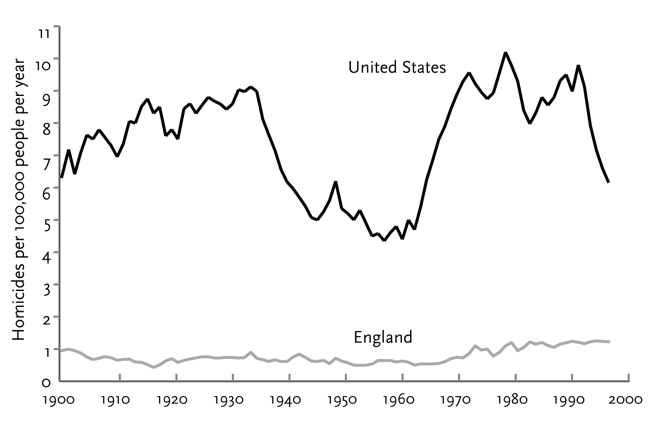
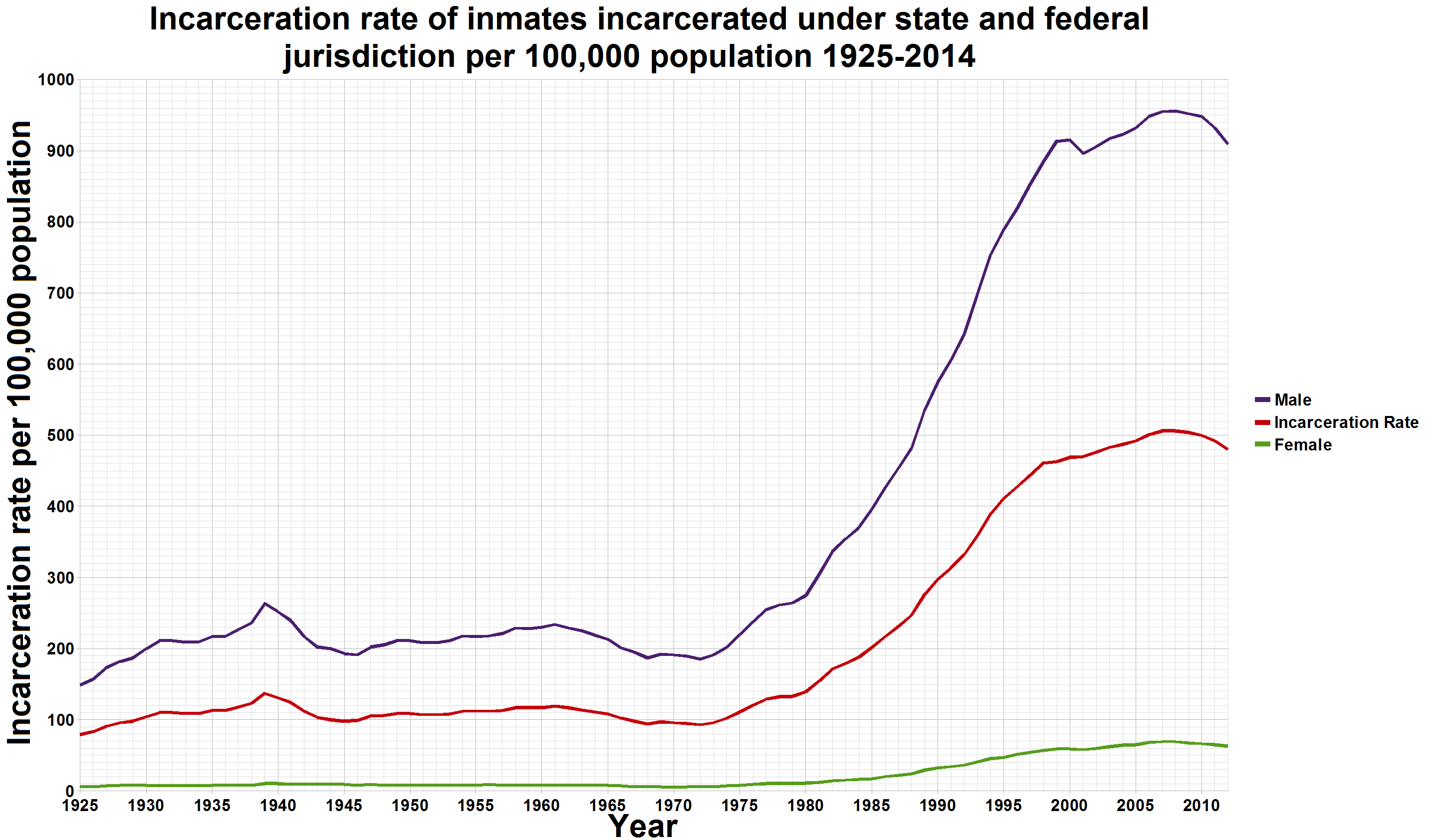
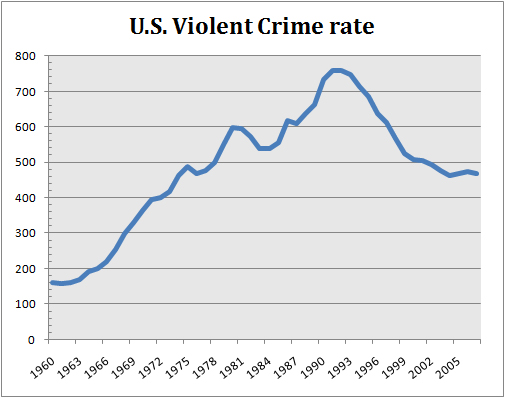
The first image is the number of homicides per capita. After hitting a minimum in the late 1950's, it starts increasing again in 1960. By the early 1970's, it's at historical highs (last seen in the 1930's). The second image is incarceration rate, which we can use as a proxy for the intensity of the drug war. Note how it's almost flat till about 1973-1974, and starts really increasing around 1975-1980. The third image is a comparison of America's murder rate to that of the U.K. Note how we have always been a dramatically more violent society throughout the entire 20th century.
The final thing to note is that the peak murder rates of the 1980's are similar to those of the 1930's. In other words, homicides went down dramatically in the 1940's and 1950's, but returned to their previous levels by the 1960's and 1970's. Don't be quick to ascribe the first peak to Prohibition, either. Prohibition lasted from 1920-1933. You can see it caused an increase in homicide rates, but the rate from 1900-1920 was already very high, and Prohibition didn't increase it that much relative to how much it went up from 1960 to 1980.
So what causes this pattern? Is it Prohibition or the Drug War? Or are those just relatively small effects on top of much larger phenomena? The social upheaval of the 1900's-1930's and of the 1960's to 1980's?
You seem to be really caught up in this idea of hard-core gang members. And, sure, it's true: people who have committed fully to lives of violent crime are deeply unlikely to turn around and become model citizens.
But: if they don't have an income to support their lives of crime, and if their leaders don't in fact have quite a nice income that the more common criminals can aspire to, there's going to be much less incentive for people who are deciding what they want to be to choose a life of crime.
And furthermore: committed, full time violent criminals are not the only people we care about here. People whose lives are impacted by the black market nature of the drug trade include many criminals who may in fact have a job, and do some crime on the side. It also includes people who are drug consumers, not dealers, who would materially benefit from a safer and hopefully cheaper drug habit.
And it also includes people whose boyfriends and fathers would not be in jail now, and if a large number of those boyfriends and fathers would not be material help to their girlfriends and children, some number of them would be.
Is this it? Is it the only policy that we would need to vanquish poverty and crime in the US? Of course not. But there's a reasonable argument that you can't meaningfully address poverty and crime without addressing the drug war -- that it blocks any other attempt to improve conditions in poor, crime-stricken communities.
> You seem to be really caught up in this idea of hard-core gang members.
I'm not. The vast majority of the gang members driving around shooting each other up are not "committed fully to lives of violent crime." But they are still "bad, antisocial" people. The 19 year old who mugs someone in a gang initiation ritual is still a bad person even if you can explain his behavior in socioeconomic terms.
> Is it the only policy that we would need to vanquish poverty and crime in the US? Of course not.
Obviously the drug war contributes to poverty and crime in the U.S., I'm not denying that. But the comment I originally replied to stated: "Interesting to see an effect of the drug war manifested on a map." As if that state penitentiary wouldn't need to exist without the drug war.
People dramatically overstate how much the drug war contributes to violence in the U.S., because their world views (usually individualist ones), don't grapple well with a world where a meaningful percentage of the population is bad and antisocial. If only the government didn't prosecute this drug war, they say, we wouldn't need these prisons! People would get along! But the data just doesn't support that narrative. Look at this chart of spending on drug control: http://cdn6.theweedblog.com/wp-content/uploads//us-drug-addi..., and cross reference that against the homicide rate chart I referred to earlier. You can clearly see that most of the dramatic increase in homicides between the minimum in the late 1950's and the maximum in the 1980's and 1990's happened by the early 1970's, while drug war spending didn't really start until 1973 and didn't really ramp up by the 1980's.
We're not seeing the product of communities ravaged by the drug war. What we're seeing is that the drug war has become the focal point for communities that were already disintegrating before the drug war even started.
Yes, but how did they get that way? They got that way because they were drawn into that life by older gang members. They see older gang members living a life of relative privilege and they're willing to accept the violence that goes along with it. If you take away the money, those older gang members become much less attractive role models.
> As if that state penitentiary wouldn't need to exist without the drug war.
From Wikipedia: "In the twenty-five years since the passage of the Anti-Drug Abuse Act, the United States penal population rose from around 300,000 to more than two million."
In that same time period, when the prison population increased over 600%, the US population increased roughly 30%. Unless you've got some other theory for drastically increased incarceration rates, that prison and many others used to house the over 1.5m extra prisoners we have today because of the WoD literally would not exist.
I spent several comments laying out a theory for the increased incarceration rates, supported with charts and graphs.
The bottom line is that the increase in incarceration rates is the result of a dramatic spike in crime rates starting in 1960, peaking in the early 1990's, and the public response in the form of harsh sentencing laws in the 1990's (three strikes, mandatory minimums). It's a simple explanation: there are more people in prison because there is more crime, and because the spike in crime caused people to vote (by overwhelming margins, I might add) for harsher sentencing laws.
The popular counterargument is that the increase in crime is itself a result of the social effects of the Drug War, e.g. the impact on kids of fathers being sent to prison for decades on drug charges. But the Anti-Drug Abuse Act was passed in 1986, and the spike in violent crime rates started in 1960. The slope of the crime increase between 1966 and 1972 is as high as at any time after the drug war really got going in the 1980's, and 80% of the total increase in crime between the 1960 trough and the 1993 peak happened by 1980. It is simply inconsistent with the data to say that the increase in crime since 1960 were anything more than moderately impacted by the Drug War, which didn't really get going until long after crime had already skyrocketed.
I tend to agree. Except that going through withdrawal is one of the most painful, tortuous experiences modern humans are likely to find themselves in. It's truly dreadful. Just knowing that torture is waiting for you around the corner can make you extremely anxious. Knowing that relief can't be found easily because of arbitrary rules makes it even worse.
Faced with such torture, people might do things they might not otherwise do.
The other article that was posted here today about the US prison problem noted that crime went down significantly after prices of crack cocaine dropped, which would be a counterpoint to the conclusion you've drawn.
The per capita homicide rate in the U.S. more than doubled from 1950 to 1973, in a consistent trend. The peak happened in 1980, but most of the increase happened in the late 1960's. Nixon didn't even coin the term "war on drugs" until 1971, and the real crackdown and jump in incarceration didn't happen until Reagan in the 1980's.
The drug war isn't helping, of course, but its unlikely to be the root cause given the timing of things. More likely the root cause is the ghettoization of the cities due to white flight and wealth flight in the 1950's and 1960's, along with the continued effects of trade liberalization taking away low-skill jobs.
If Indianapolis's incarceration stats are similar to those of Illinois, a plurality of inmates are there for domestic violence.
Later
Nope; significant domestic violence, but mostly property crimes. Lots of drugs, too; Indiana breaks out meth (a scourge in the midwest), and meth seems to be the dominant component of drug incarcerations.
I wish maps like this would label in which order they draw the dots. It makes a difference.
This one, for instance, appears to draw (bottom up) "White", "Black", "Hispanic", "Other", "Asian" - this over-represents the races higher up on the list, especially in densely populated areas. That solid block of red? It probably has other colors underneath, but you can't see them, and they don't tell you this.
This is one of the nicer maps like this that I've seen, but excluding that info is blatantly misleading.
Even better, why not just let people enable/disable the ethnicities? Could even make it so it draws the most recently enabled race on top of the rest. I'm trying to get an idea for where each ethnicity lives and it would be so much easier if I could just look at one at a time.
Yeah, I've seen a rare few that offer this, though usually not re-arranging which are on top. It's usually surprising just how biased the default display is :\
That said, it still surprises me that these map makers (all of them! not just this one) don't take the simpler approach of drawing all dots in a random order - e.g. get rid of this "first all blue dots, then green, etc" behavior, and pick the next dot's color randomly, while maintaining the distribution. Then you'd have an unbiased "top layer" regardless of the size of your dots (up to a point, obviously).
(hard to describe what I'm thinking of... basically `[red, red, ... * 25, green, green, ... * 10, orange, orange].shuffle.draw` rather than just `[].draw`)
1 dot = 1 person. Zooming in and out doesn't expose any particularly bad distortion of the underlying data at the lower zoom levels.
It seems to work really well to me, is there region in particular where you see a problem?
Otherwise, just look around at densely populated areas. Like this asian-heavy area: http://cl.ly/image/1z0Q1T1V2V0N (edit 2: turned off smoothing, that's actual pixels) note that immediately-surrounding areas have blue dots, but not that one. Meanwhile, you can see less than one dot sized dots for orange and blue poking out, but no orange or blue complete dots on top of the red. Look at other dense areas, you'll see the same thing - some colors are exclusively on top of others, and it's always the same ones. (edit: for context, that block is in the middle here, in San Francisco: http://cl.ly/image/3m3N3f423S0M)
There isn't enough room for them to have fit one person per pixel, so they're stacked (somewhat). This favors the ones stacked on top.
I don't know if it's the color choices, the dot placement, or some combination of the two, but this appears misleading to me. Looking at the Central District in Seattle, one could be forgiven for thinking it is a majority black area.[0] In fact, African-Americans only make up ~20% of the population there (very high for the PNW, but hardly a majority). The New York Times census map gives a far more accurate image of the racial demographics of that neighborhood.[1] I believe the NYT map only has one dot per 100 people, which means the dots are larger and less crowded. Notably, the NYT map uses green dots for white population and blue dots for black population - the reverse of the map linked here. That means if the color choices are having an impact on the way we perceive mixed neighborhoods, the effect is the opposite depending on the map you look at (i.e. you are more likely to think a mixed area is majority black when looking at the OP map, majority white when looking at the NYT map). It's worth thinking about color perception and optical illusions when viewing maps like this.[2]
I love map-based visualizations - they're interesting and fun to look at. Nonetheless, I don't think they're the best way of conveying demographic information.
EDIT: Groxx has a fantastic comment about the order in which the dots are drawn. This could explain my observations.
Yeah, colors are hard. Compare the full saturation red they are using for Asian to the baby blue for White. The red stands out more than the blue, even though they are both supposed to represent one person.
Is this correct? I thought the Hispanic and the black are like 40~% already, the picture still give you the impression that non-white is something just like 5%
Also, there are only two melting-pots, one in NY and one at CA, per the picture.
Only if you count the 17% who are hispanic as white, otherwise it's 62%. But Hispanic white people will probably stop being viewed as a separate racial groups before that long, as happened with the Irish.
That may be partially true. But this topic gets very murky, very quick.
Spanish are just as white was the rest of the Europeans. It was back about 450 years, when the Spaniards came over to the Americas and made what is called the Hacienda. Just like when the USA had their racial times regarding Africans, the Spanish did so to the natives here. What happened was a mixing between white Spanish and Incans, Aztecs, and Mayan descents. After much institutionalized slavery and racism, mixed with rape and destruction of the culture, we end up with people called "Mestizo", or mixed.
What we think of as Latinos, or Mexicans, or other derogatory words are the result of 450 years of slavery, rape and destruction of their culture.
Unfortunately, what happens is that the Spanish are the whites, and the Indians are the native cultures. Then you end up with Mestizo, which somewhat maps to the word Nigger here in the US. And unlike our incursion with slaves in the US, the Hacienda system lasted for almost a half a millennium.
Mestizo means mixed. And that's what they are treated as. Not good enough to be native, and not 'pure blood'.
> Then you end up with Mestizo, which somewhat maps to the word Nigger here in the US.
This is absolutely false. Mestizo is a normal and accepted term both in the US and throughout latin america. It is not considered an insult anywhere, unlike Mulatto. What else would you call us mixed people?
> Not good enough to be native, and not 'pure blood'.
Again wrong, most racism south of the US border is towards the indigenous. Mestizos see themselves as superior, since we are both european and native. While the aristocracy may look pure european the majority of latin american countries are mestizo and is a big source of pride and identity.
It's interesting to note: in the late 1960s Denver was quite segregated. A 1974 Supreme Court decision led to students being forced to ride the bus across town to mix with students of other races (I rode from southwest Denver to Five Points for a few years in elementary school.) One of the major results was white families moving out of the Denver city limits. They ended forced busing in 1995.
Denver now has one of the most diverse populations in the US, though it's often hurt by measurements that treat "white hispanic" (22%) and "non-hispanic white" (50%) as both just white. Denver is home to the largest Mongolian population in the US, one of the largest Native American Pow-Wows in the US, plus significant African American, Chinese, Japanese, Jewish, Russian, Polish, Ethiopian, and Lebanese groups. While there are some enclaves, there are a lot of very mixed neighborhoods as well.
The race section of the full Census data tables is actually quite large (something around half the total data), breaking race down into a host of combinations of varying degrees.
So many great data analysis exercises that could be run with such a set. Effectively, you could create scalar variables representing lots of different population statistics on a country, state, city, ect level.
And that doesn't even cover stuff that's harder to show like gradients, edge analysis (who's likely driving between two towns?), or migration patterns if multiple census years are available.
FWIW, having moved from the St. Louis area and traveling through Ferguson MO on a daily basis, it's obvious to me the racial makeup is a symptom/result of economics. Race + economics is a hard ship to steer, for sure.
It is truly another world, with so much wilderness. This difference changes the culture greatly as well, and how people think about land, the earth, and other people.
You can find good people and good places everywhere, but the west really is better in nearly all respects.
Hence the importance of liberty as an axiom of federal governance: one group with particular cultural interests (say, deep urban) should not impose their situation-specific views on others far away with radically different cultural interests (say, rank wilderness). What some may find need to prohibit in one situation, others may find necessary to survival in another. The lack of respect of axiomatic liberty causes dangerous sociopolitical tensions.
Very true. Sadly, the reality of the structure of our government is such that rural areas have a greater representation in our governance than denser more urban areas.
Us rural types find the reverse practically true, even with representation explicitly skewed in our favor: urban centers regularly out-vote us by a long shot.
On the down side, this appears to show "white Hispanic" as white, which makes Denver look like a giant sea of sameness instead of one of the most diverse cities in the country.
I understand and reject that reasoning. When you're mapping diversity, put me and my pasty-white Anglo-Dutch ancestry and my neighbors who grew up in Mexico in different categories.
And that is your right, you can make your own map, the census is freely available. It isn't a 'diversity' map, it is a map showing census data for race, income, household size and age, not ethnicity.
This is fascinating. It really shows how racially segregated a lot of cities are. But from my knowledge of a few cities where I've lived, all the "cool" places to live are very mixed. Not sure if that says more about my idea of desirable places to live or the effects of gentrification, but this map is definitely very thought-provoking.
If you're talking about NYC or San Francisco or the like, the "cool places" are ones where higher-income white people are pushing out the lower-income minorities that used to live in those neighborhoods. The mixture is temporary.
I find the fully-zoomed in view to be the most fascinating. To be able to see the administrative lines appear, like the diamond of DC, even though it's one gigantic metropolis almost all the way up to Baltimore. And definitely confirms what I already knew about Philadelphia: extremely segregated.
Anyone notice the triangle of people floating in the empty space at the southwestern corner of San Francisco near Lake Merced? That appears to be the Olympic Club golf course. Do people actually list the golf course as their home address on their census forms?
Dots should darken (or enlarge) when zooming in; as-is, because the dot-density decreases, the image as a whole lightens and becomes difficult to see at high zoom levels.
Its a tough problem, the "real" physical solution is bad the other direction.
If I zoom out to see the whole contiguous 48 states, each pixel on my screen is about 10 square kilometers. Consider filling the screen with that 10 square kilometers. For say, San Francisco, that gives me 13000 people to place in something like a million pixels of white. That is a nice density for a dot map, but my screen is mostly white. If we want to keep the color density, when we zoom out to see the country, even San Francisco is going to be a mostly white pixel.
With continuous smooth zoom you could smoothly change the size of the person dot from a 1/10th of a pixel to one pixel and probably come up with a nice effect, but you'd need to be rendering at 30fps or so to be smooth and this web site doesn't seem to be built for that.
> Each of the 308 million dots are smaller than a pixel on your computer screen at most zoom levels. Therefore, the "smudges" you see at the national and regional levels are actually aggregations of many individual dots. The dots themselves are only resolvable at the city and neighborhood zoom levels.
However, it would depend if high levels of smudging max out the color intensity of a pixel. This could be solved with normalization, but I don't know if they did.
Geography and climate. The western US is very mountainous with lots of desert areas.[0] The east, in comparison, is very flat with plenty of water and climates more suitable for farming.[1] Population in the west is therefore more clustered around the few areas suitable for human settlement.
If you're talking about the racial population patterns, that's a product of history and geography (again). European settlement of the US started in the north-east, African slaves were brought mainly to the south-east and Hispanic migrants come largely from the south, across the border with Mexico.
I don't think the chosen palette is perceptually uniform in intensity, either, at least not on my display. A whole whack of white people (sky blue dots) looks less populous than the same number of Asian people (red dots)
Where do you want to "go" as a society? Is the goal to have the same "diverse" racial distribution in every community? I for one am ok with people living in communities that are mostly of the same race. I think these communities preserve cultures better. Something I personally would not like to see disappear. For instance, I would not like Chinatown to become 50% white, 20% black, 20% hispanic and 10% asian or something. I think that would be terrible. As long as there isn't legislation that is forcing or evening economically coercing people to live in segregated communities, I kinda like just having the chips fall where they may and people live where they feel comfortable.
I also wonder what other countries would look like if this same analysis was applied? My guess is that you'd see the same basic result. Cities more diverse, rural areas less. Within cities, you'd still find segregation.
"we don't want a 'melting pot'. We don't want everyone to become the same. We want something more like a 'mixed salad' -- all the pieces bring their own unique flavor and contribute to the whole. It's OK if some bites have a little more tomato and others have a little more carrot. Just don't be that picky eater who pushes all of the cucumber off to the side like it doesn't belong."
The actual title of the submitted resource is "The Racial Dot Map: One Dot Per Person for the Entire U.S." I'm pretty sure that this has been submitted to HN before. It loads rather slowly on my computer here. A zoomed-out view does do a good job of showing the remarkably low population density of the Great Basin in the western United States, which was formerly known as The Great American Desert. Presence or absence of sources of abundant fresh water has a huge influence on population distribution in the United States.
A zoomed-in view of my metropolitan area, the Twin Cities of Minnesota, shows the overall conurbation of the two cities and their suburbs reasonably clearly, but with some rather odd blank spots on a closely zoomed-in view that appear to correspond to census tracts with few actual residences, not matching the actual distribution of built-up or undeveloped areas in quite the way that most residents of this area would expect. (Some of the blank spots in south Minneapolis correspond to lakes in the City of Lakes.) Of course an industrial park can have a high daytime occupancy of interacting human beings while being almost empty at night, and the other way around for a residential zone.
For any data collected by the United States federal government about race, one has to go to the definition statements from the Bureau of the Census: "The U.S. Census Bureau collects race data in accordance with guidelines provided by the U.S. Office of Management and Budget (OMB), and these data are based on self-identification. The racial categories included in the census questionnaire generally reflect a social definition of race recognized in this country and not an attempt to define race biologically, anthropologically, or genetically. In addition, it is recognized that the categories of the race item include racial and national origin or sociocultural groups. People may choose to report more than one race to indicate their racial mixture, such as 'American Indian' and 'White.' People who identify their origin as Hispanic, Latino, or Spanish may be of any race."[1] All of the definitions are arbitrary, and some are very arbitrary indeed and imply divisions of personal behavior that don't exist in actual practice. (My household is poorly defined by the Census data gathered under the OMB rules, and I live with people of another "race," whom I prefer to regard as my fellow human beings, every day of my life.) In Minneapolis, it's not a big surprise to see concentrations of "black" people (historically African-American people in north Minneapolis and recent Somali immigrants in south Minneapolis). In St. Paul, the "Asian" people are mostly recent Hmong immigrants. Hispanic people (mostly recent immigrants from Mexico) have increased greatly in number in this area in my lifetime. A typical set of signs at a public library in the metropolitan area will be written in English, Spanish, Somali, and Hmong here.
Re: "rather odd blank spots on a closely zoomed-in view"...
> The locations of the dots do not represent actual addresses. The most detailed geographic identifier in Census Bureau data is the census block. Individual dots are randomly located within a particular census block to match aggregate population totals for that block. As a result, dots in some census blocks may be located in the middle of parks, cemeteries, lakes, or other clearly non-residential areas within that census block. No greater geographic resolution for the 2010 Census data is publicly available (and for good reason).
man I am so tired of races. divided and labeled in every possible context. what the hell is white anyway. a mixture of millions of unknown origins, only you happen to come out with a pale skin.
Part 1 of 7 (linked above) is 10 minutes long and worth watching. It is NSFW only because of the intro clip from Spike Lee's Do The Right Thing. The series of videos contains an introduction by kruger97 (his Youtube name; I don't know his real name), then an interview with Stuart Hall, then a speech by Hall.
°o(Apartheid is huge in america!) I have some business ideas! Racially segregated car sharing! Racially segregated clothing (ok that one might be too flooded already) Racial Segregation -- the Magazine(!) DOWN VOTE NOW!





I thought whoa that's cool, a dense little community of minorities.
Turns out: https://www.google.ca/maps/@39.6908437,-86.4131159,15z
Damn it.