The whole "high-art = big money" mindset is what ruins everything. Just let it be. It's an image that people enjoy looking at, and it's right there for everyone to see - touchable, fragile, transient. Giving it a monetary value defeats the whole purpose of it. It's not meant to be preserved, it's just a curio that livens up the outdoor scene.
Stop valuing it so much - it's meant to be weathered and destroyed. Enjoy the art for what it is and let urban nature take its course.
This is one of those things, like complaining that the developer of a webapp you like "sold out" to a large company, that sounds nice unless it's your app with an offer or your building that just got tagged by Banksy. The owners of this building didn't assign the value; they inherited it. In any case it would be plain dumb to ignore it and I have no idea why anybody would upvote a comment suggesting that they do so.
My comment isn't direct at the individual in this article; I don't blame them for what they did. I just was thinking the whole culture that's evolved out of this is kind of annoying. Our society had the opportunity to just enjoy some cool images, but turned it into some stupid meta-drama.
The whole point of these works is to bring out this drama and highlight the absurdity of it all. It's not absurd in the sense that people are acting irrationally, but absurd in how our culture treats art as some mystical thing that has to be set on a pedestal behind protective glass. We've elevated "art" into something that supposedly only highly-cultured people can appreciate, and shut it away from the layperson.
By doing his art in the cheap and fragile form of graffiti, intimately accessible to everyone, he's giving art back to the people. It's just a simple creative expression for a creator to enjoy sharing. Yet, as Banksy surely predicted, we've tried to apply our weird notions of art onto it, that it should be locked up, cut out of the wall, sold for millions, viewable only to the elite.
There's no easy way out, because no individual is incentivized to change, yet society as a whole needs to change.
it would be plain dumb to ignore it and I have no idea why anybody would upvote a comment suggesting that they do so.
I upvoted it because I was going to write essentially the same thing.
I've been thinking about it since Colbert publicly non-invited Banksy to paint the wall outside his studio. I don't believe that dollars are an appropriate unit of measurement for life experiences. I do believe that graffiti and others forms of street art are intentionally impermanent and functions of their location.
I would support trying to sell it if the building owners were living hand to mouth, but that's obviously not the case. The author's already monetized the "inheritance" by selling a literary "piece" to NY Magazine. She doesn't need to sell it so leaving it as part of the gestalt the artist created is the greater good. If it gets defaced by some other graffiti artist or the police/Bloomberg (who are only feeding the frenzy with their attitude) then so be it, the limited lifespan of graffiti is an inherent part of the art. Like making sandcastles.
I would probably set up a hidden video cam in case someone else came along and tried to steal it. Not that the stealing is necessarily a problem for street-art, but taking it would involve damage to the building itself and that would be unacceptably outside the scope of screet-art.
I don't believe that dollars are an appropriate unit of measurement for life experiences. I do believe that graffiti and others forms of street art are intentionally impermanent and functions of their location.
But Banksy isn't graffiti in general or something other people decided was worth money after someone just did it for joy. Banksy's shtick is calculated to generate publicity and a whiff subversion specifically as a part of him maintain his position as a highly paid, highly valued, highly publicized. Banksy could have gone to NYC and done anonymous graffiti for year and no one would have notice if there wasn't any publicity.
I don't understand your attitude. Money is a very good way to genuinely quantify the value of something. Putting a dollar amount on a piece of art means people do enjoy looking at it for what it is. Unless you're defining "value" in some manner unfamiliar to me, you can't say "enjoy it" but "stop valuing it."
But don't you see, you're missing the entire point. Banksy is a graffiti artist. At no time have any of his works been capable of being bought or sold. His graffiti has routinely been lost, painted over, weathered, or ignored. That is the whole point of his work. Not only that, but often the point of his work is to devalue some other seemingly valuable thing--witness his Ronald McDonald statue[1].
Just because some rich people feel like attaching monetary value to most art doesn't mean Banksy's art has to fall in line. It's not like you're going to take down a section of wall and sell it, and someone did, he would also be missing the entire point.
Just be happy that cameras exist and take a picture.
If people enjoy seeing it it seems decidedly churlish not to preserve it for future generations. As does someone who can only enjoy it because other people won't be able to.
As for missing the point, I'll raise you death of the author. A piece of art must stand on its own merits, not the intentions of its creator.
But you can't preserve it for future generations, because the location and inevitable impermanence is part of the work. By covering it, you'd be defacing the work to protect it.
Yes, generally we do, and I'd agree for graffiti done in canvas or similar mediums, but I think street art is an obvious exception, since the canvas is the whole street. You could only preserve the artwork by preserving at least the whole building, and possibly more than that.
Are people going to enjoy looking at it less if the building changes (assuming the painted part doesn't)? My guess is that the overwhelming majority of the enjoyment will be preserved.
The whole "high-art = big money" mindset is what ruins everything. Just let it be. It's an image that people enjoy looking at, and it's right there for everyone to see - touchable, fragile, transient.
I agree but I'd like to point out that Banksy is as much a part of the "high-art = big money" as the galleries and the press.
I agree, and I think the message is clear: we've perverted what people call "high art". To paraphrase another post I made, we've raised "art" on a pedestal behind protective glass, as something that supposedly only highly-cultured people can appreciate. We've applied this perversion to Banksy's graffiti in a very ironic way:
People want to preserve the paintings, even though they're intentionally transient. They want to cut them out of the wall, even though the environmental context is critical to the piece. They want to sell them for tons of money, even though it's been freely given in a public space, for everyone to appreciate.
In short, people want to destroy the whole artistic value of the piece in order to increase the monetary value. I guess all that remains is the meta-message that predicts this outcome.
Value in art comes from excess of money in too few hands. Much too rich people need investment vehicles, and because of this sad state of the matter art, collectible cars, London flats and many other rich toys get ridiculously expensive, completely disconnected from any sense of utility or real value of any sort.
Mayor Bloomberg's reaction is interesting - I'm curious to know when a person transitions from vandal to artist. I don't think anyone could argue that Banksy hasn't cemented a place in the 'history of art' and the books our children read that cover this period will feature his work.
In the UK a lot of people are genuinely gutted when a Banksy gets removed or covered - like something (a gift?) has been removed from the community. People who have their buildings 'vandalised' are often incredibly proud. But at the end of the day, it's still graffiti, still vandalism and I can understand Bloomberg's zero tolerance attitude. I wonder how he'd feel if it was on a building he privately owned (not that he needs the money...)?
If he says the city condones Banksy's work then he's going to immediately get asked "Who's job is it to decide which graffiti is art and which will get you arrested?" He's got 10,000 more important things to deal with so he just says it's vandalism and will be treated as such and then moves on to the rest of his day.
"For $41 million — what Citibank paid to sponsor the program for five years — our city bikes became Citi Bikes. To make certain you don’t forget this fact, a Citi Bike sign hangs in front of the handlebars, Citi Bike is printed twice on the frame, and a Citi Bike billboard drapes the rear wheel on both sides. The font is the familiar Citibank font and the Citibank signature decoration floats over the “t.” There is no way to see a Citi Bike without thinking Citibank. The 6,000 bikes so far rolled out, of a possible 10,000, and their signs are a Day-Glo cobalt blue that you see on banks. Nobody wears this color. Nobody paints his or her apartment this color. This blue is bank blue."
Haha funny, I was in NYC recently as a tourist and my brother and I, we rented the bikes for a couple days to drive around. I know Citibank, but I didn't pay the slightest attention that the Citibike has anything to do with the bank.
There is no way to see a Citi Bike without thinking Citibank
If I consider my own experience, I'd say it's pretty easy to miss on that.
Why can't vandalism be an artistic medium? I don't see any reason why someone can't be labeled both "vandal" and "artist". (edit: re-reading my sentence an hour later, I think even better wording might be "an outlet for artistic expression" rather than "an artistic medium".)
That entirely depends on your definition of “vandalism” and that is an extremely boring discussion to have. It’s quite pointless, actually. Who cares about the definition of what is and what isn’t vandalism?
Extract:
Initially The KLF's earnings were to be distributed by way of a fund for struggling artists managed by the K Foundation, Drummond and Cauty's new post-KLF art project, but, said Drummond, "We realised that struggling artists are meant to struggle, that's the whole point."[12] Instead the duo decided to create art with the money.
I’m talking about definitions and the argument about definitions that’s happening here. Arguing about definitions is foolish, it’s point- and meaningless. Who cares what vandalism is? The important thing is how one views a certain act, not how one defines vandalism. That only clouds the issue.
Also, I find people who think there are absolutes when it comes to this issue extremely funny.
I don't think arguing about definitions is pointless, although it often turns out that way.
Take, for example, the classic "if a tree falls in a forest and no-one is around to hear it, does it make a sound?". Resolving this question comes down to seeing that it depends on how sound is defined: pressure waves in the air or a neural state change related to those waves hitting an ear.
Once we see that a words (like "sound") has several definitions it allows us to see the world more clearly. Perhaps we invent new words for the sub-concepts that are generated.
That tree example perfectly illustrates why arguing about definitions is pointless. There is no reason at all to ever really disagree about definitions (except maybe for convenience).
However you define sound, the material facts of the situation are unchanged. You do not change anything in reality by defining it differently, you are merely changing something in your brain, i.e. how sound is represented inside it. That is also why the tree question is anything but deep. It’s extremely straightforward, there is no mystery, it’s only our brains screwing up (in the way it represents things).
Therefore, if it seems like some word is differently defined by different people all that has to be done is that everyone has to make clear what their definition is, that’s all. There is no point arguing about it, there isn’t even much point in trying to come to an agreement (except convenience).
If everyone know everyone else’s definition of something it’s perfectly possible to talk about it, even if all individual definitions are contradictory, it would just be hard to keep track of everything.
I don't see why they couldn't be both. They're a vandal when they do it without permission on someone's property. They're an artist when they decide they're doing it out of creative expression. That doesn't necessarily mean they're automatically a good artist, but an artist nonetheless.
The curious other part of the story is watching the train wreck of someone transitioning from a real estate owner to an art owner suddenly without any idea what they're doing or any plan.
The article is seeping thru with "I have no idea what it means" and so on. Well, what it means is you are not an art owner-type but are suddenly an art owner anyway, so you'd best sell that shack or otherwise get rid of it or remove it from the owners control before screwing it up, probably permanently and certainly very publicly.
The story wouldn't read any differently had someone tied a cow to her fence and run off. "I'm the accidental owner of a heifer" and "I have no idea what it means". Well, you're not going to figure it out quickly so use the magic of the market to hand it off to someone who does know what to do.
Its a popular, overdone trope, think of all the hollywood sequels along the lines of "three men and a baby".
I could chisel down Michelangelo's David statue into a skeletal structure of David. I'm sure you could appreciate that both as art and an act of vandalism.
That's a nice aphorism, but it's too vague; obviously we wouldn't condone artists breaking rules against child abuse or murder. Figuring out where to draw the line is the hard part.
One could argue that if an artist breaks a law to make a statement (about either the law itself or wider sociological issues), then your perspective of the morality of the act could be influenced by whether or not you agree with the artist's statement.
Okay, fair point. I'll revise: the job of an artist is to break the rules intelligently.
Also, I think you're conflating legality and morality. I can think of situations for all 8 cases of (legal|illegal)(moral|immoral)(agree|disagree). However, you're probably right that agreement/disagreement influences morality judgments.
So probably neither Raphael nor obviously Murillo nor Gongora nor probably any romantic poet were artists. Not to talk about the Egyptians.
I do not know about Shakespeare 'breaking' any rules, or any pre-XIX Century painter. Or the Greeks, you know? What rules did the Parthenon's architect break? Or the sculptor of the Laocoon group?
The 'breaking rules' stuff is all very well for some things but it is not the definition of art. Please.
(Spanish examples because I am a Spaniard, but you understand).
Oups? I do not get this answer and never was my intention to be incivil. Mmh? Sorry if I hurt you but I was just being as clear as possible. And as assertive as the sentences I was reying to.
Possibly the 'please' in my comment is paternalistic, but then again your definition of the job of an artist is quite simplistic. So it may not be paternalistic but a plea for sensible speculation.
Alright, thanks for taking me seriously. I'm feeling a bit touchy today. I think the problem is that I'm using the words artist, job, rules, authority, and creativity in a very liberal way.
I guess my general point is that to be an artist, you have to be creative. To be creative, you have to do something new. To do something new, you have to depart from what exists in some way. Whatever exists can be called authority, tradition, or "the rules". And then something new is a challenge to that authority. If you build a skyscraper in a town with no skyscrapers, you are challenging authority, even if all the other towns have skyscrapers. When parents make a baby, it's a creative act, and the baby ends up challenging the authority of the parents; the baby breaks the existing rules of the family structure. It's the same with the work that an artist does. It doesn't have to be socially rebellious in nature. An expression of beauty that has not been seen before is breaking the rules about the limits of beauty.
Even more generally speaking, when an artist does manage to break the rules, they end up challenging our preconceptions of what can be - these preconceptions are the true "rules" - and it opens us up to a deeper experience of the world. As examples, anything that creates a feeling of awe, anything that touches on sublime beauty, is operating on this level. I think if you look closely, all of the artists you named are working in this way; it's not mere repetition of what came before.
I think it's an artists job to get the viewer to take pause and reflect. Whether that means reflecting on the state of society, the human condition, sexuality, property owner rights, or the raw beauty and majesty of nature, doesn't really matter.
That idea is a relatively recent one, starting with movements like the fauves. Throughout history prior to that, the job of an artist was to produce work his patron/client was satisfied with.
Some would argue that even those now 'breaking rules' have been subsumed by the massive market around art - as soon as the price tag is astronomical, and the method of display only a safe gallery, the rebellion has been captured in aspic and rendered safe.
Banksy is an interesting take on this as much of his work is trying to break out of the confines of the gallery, but he has still been trapped in a system he's at least partly unhappy with by the rising value placed on his work, and has resorted to trying to undermine this with stunts like that $60 sale. It's interesting that the perceived value of the spraypaint with his signature has resisted even that sort of rebellion.
So I don't think saying it must be provocative or break the rules is a very good definition of art, indeed, for most people, even those buying faintly rebellious work in the 20th/21st century, art is decoration (I don't mean that in a derogatory way, but that is how it is consumed), rebellion is an optional extra.
I see what you're saying, but we probably don't have the same interpretation of the words 'job' and 'artist'. More broadly, the nature of creativity is to challenge authority. Look at any time period, any medium, and the most creative work is always going against the grain. Breaking the rules can be as simple as using an uncommon kind of brushstroke. It doesn't have to be against the wishes of whoever is paying for the work, and furthermore, just because something is challenging authority doesn't mean it's creative.
Look at any time period, any medium, and the most creative work is always going against the grain.
You are indulging in a circular definition in which most creative stands in for best or most worthy art, which of course depends on the premise which you set up in the first place, and which is a peculiarly 20C view of art. Only with the break down of the patron system and in quest of a new definition of art and a new place in the world did artists turn to the idea of being a creative force challenging the status quo (economic and artistic).
I don't think Michelangelo for example would have recognised your definition of his art as only meaningful in as much as it breaks the rules. His art was almost all in service of the church, which was the dominant political and economic force of the time. You can try to rewrite the history of art as a history of innovation and rebellion, but why bother? Why not understand it in its totality, which is certainly not as an instrument of rebellion, or even as a force for change - for much of the history of art change was gradual and consensual over decades and centuries, and nothing to do with challenging authority, quite the reverse, it was usually in the service of authority, used as propaganda, teaching materials and social proof. Art was a useful craft for most of its history.
Great art can include rebellion, but it is not confined to it, and frankly I think you're defending a pithy but inaccurate slogan which falls far short of capturing the full role of art in our society.
That was unnecessarily condescending. Incivility is against the guidelines. What I have to say doesn't lose its validity simply because you shame me for my point of view. If you were sure enough of your position, you wouldn't need to humiliate me about mine.
Incivility is against the guidelines. What I have to say doesn't lose its validity simply because you shame me for my point of view. If you were sure enough of your position, you wouldn't need to humiliate me about mine.
I struggle to see what you would find humiliating in either my post or pfortuny's above - you issued a remarkably general assertion (all art is x in any medium, in any time period) which is in my view invalid, and I offered a counter-example.
In my post and I believe pfortuny's there was no attempt to shame you for your point of view, just a disagreement with that point of view based on our understanding of art history. Disagreement is not incivility.
If you disagree and this is true of all things considered art you should be able to reel off lots of examples and easily disprove the counter-examples given, since your assertion holds true universally.
> I'm curious to know when a person transitions from vandal to artist.
Asking for a transition point makes the assumption that they are mutually exclusive. But Banksy is by any reasonable definitions both a vandal and an artist. Hence Bloomberg is simultaneously cleaning up vandalism and destroying art. Whether you think this is a good thing depends on how you weigh these two aspects. Personally, I think it just makes his work more precious. It is the nature of the medium that his work is temporary.
I agree with you completely. But there's a mindset needed from most people before they make the jump from 'vandal' to 'artist' - or vandal artist! There are a lot of graffiti artists doing fantastic pieces - but it'll always be seen as vandalism.
With Banksy a lot of people (certainly in the UK) don't even think of the vandalism, they jump straight to artist - something they probably wouldn't do for a lot of other graffiti. Why so? Publicity? Celebrity sales? The fact the piece has immediate value?
> But at the end of the day, it's still graffiti, still vandalism
It's not vandalism if the owners of the buildings are happy to have the piece.
If I scrub a brick wall clean, is it vandalism? No.
If I glue a solid pound of gold to a brick wall and the building owner takes it, is it vandalism? No.
If I have a work painted on my property that draws crowds and will probably have a "market value" of a lot of money, and I'd rather have the work have been painted than not exist, is it vandalism? No.
If I'd be happy or even would actively desire to have a Banksy piece painted on my property, is it vandalism when it does happen? No.
> If I scrub a brick wall clean, is it vandalism? No.
> If I'd be happy or even would actively desire to have a Banksy piece painted on my property, is it vandalism when it does happen? No.
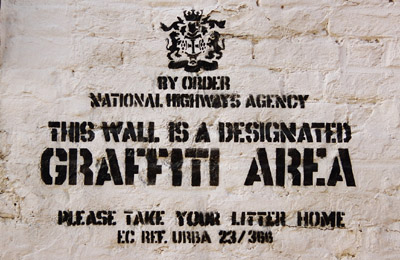
Haha, reminds me of when Banksy would turn up in a van and overalls in the middle of the day, whitewash a wall and then stick up a 'Designated Graffiti Area' sign.. The wall would be covered a few days later... :-)
yes, but you cannot assume that 'the owners' are all happy. Some may be but some may not be. I probably wont be. For those who are happy, fine; but for those who aren't, I would struggle to see how that wont be characterised as vandalism.
This is a criminal matter, not a civil matter. It's just like if a guy punches me on the street, but I decide it was cool and edgy and added to the gritty vibe of the neighborhood. The prosecutor can still bring charges.
Surely not. Better question: is "vandalism" without criminal trespass or property damage actually a crime? If it's on private property, and the property owner enjoys the painting, it seems like it'd be quite a stretch for the state to establish that the artist damaged the property by creating it.
You badly misunderstand something. The Streisand effect is an unintended consequence whereby trying to minimise attention actually increases it. "Banksy" has known all along that maintaining the mystique of secrecy would create attention where otherwise there would be none. So the exact opposite of the Streisand effect. His secrecy is to create attention, not avoid it.
The Streisand effect in this case would be Mayor Bloomberg's reaction, threatening to destroy any of Banksy's artwork found and arrest him if possible.
Honestly, he couldn't pay for that kind of publicity, and unless the good Mayor is actually in on it, Banksy must be grinning from ear to ear at the irony.
I'm not talking Banksy's secrecy. I'm talking about the effect of provoking authorities and having their condemnation generate publicity that provides more incentive for Banksy.
The line to me is clear - tagging is vandalism, but if it exists to send a message it's art. A high level of skill is required to make art, either aesthetically or emotionally. Of course there is the grey area where a tag can be so well done you're questioning if it should be in a gallery, but by then the artist has built up a large repertoire of skills.
Writers used to have some untold rules. Nevertheless tagging / grafiti is at its core, and before being an art form, a subversive means of expression for people that usually are invisible.
Why do you think writers use names like ads ? This is a quest for identity by people that have essentialy been made transparent and ignored by society. They reclaim urban space. "This is mine too, it has my name on it". "You can't do as if I didn't exist".
Being the target of such vandalism is no fun, for sure. I have been. When I did, I tried to remind myself tags are scars forgotten kids draw into average and blind people's landscape.
In this world of writers Banksy is a pacifist. He's addressing average people in their own language. He's talking to us with subtlety and good points, he's touching us, instead of shouting on us.
Be it him or any other writer, don't kill the messenger. If tags are pimples, then our society is sick. Would removing the symptoms cure the disease ? I doubt it, and I guess you do too. We know this all too well for a long time but still don't act on it as a group. These are only reminders, or first symptoms, of what is to come if we continue to indebt ourselves to other human beings. They'll reclaim.
Nearly everything is art... that's the thing... art is a category. Something doesn't have to be good to be art. Something doesn't even have to have a message to be art. A big black rectangle painted on a canvas, while not considered very good by most, is still art.
Not all graffiti artists practice on buildings. Plywood is cheap.
Of course, tagging in public, perhaps in a hard to reach place, is a separate skill requiring its own practice... I'd just prefer they did it after having practiced the tag in their backyard first. Like Banksy.
Part of the skill in getting up, is getting up without getting caught. If you support full pieces, you shouldn't complain too much about people practicing with tags (although most people do complain).
The solution is of course to have legal walls. But that would be far too progressive for most councils.
I think you're probably correct - and as I said, I think the 'man on the street' attitude in the UK right now would very much be that Banksy is an 'artist' rather than a vandal. I suspect this has a lot to do with an enormous amount of very favourable national press coverage.
The definition of art is more a philosophical question that varies from person to person, so getting consensus on defining what Banksy is is bound to ask the question. Perhaps that's one of his objectives.
Well, most art critics don't take Banksy seriously, so I wouldn't count on him having a place in the history books any more than a novelty musician like Weird Al, for example. In fact that comparison makes Banksy sound more important than he is. David Blaine, maybe?
http://www.theguardian.com/artanddesign/jonathanjonesblog/20...
It’s funny he contrasted Banksy with Pollack. I’ve always thought of Pollack (and many other modern artists) as a sort of charming guy who figured out that the art industry is a weird product of status games and so decided to create positional goods with the least amount of effort possible.
I find Pollock's works legitimately amazing, and I don't really like much modern art.
Modern art is usually full of clever subtexts and messages that aren't apparent to outsiders. Like a really complicated and abstract piece of jazz music.
Ask a knowledgeable modern art fan to decrypt some paintings for you sometime, it's quite interesting.
You are talking post modern art , not mordern art.Art died when it became highly speculative.But it did not die today, by the time of Picasso it was already dead.
Notice the performance in the following description of Pollock at work:
>A dripping wet canvas covered the entire floor … There was complete silence … Pollock looked at the painting. Then, unexpectedly, he picked up can and paint brush and started to move around the canvas. It was as if he suddenly realized the painting was not finished. His movements, slow at first, gradually became faster and more dance like as he flung black, white, and rust colored paint onto the canvas. He completely forgot that Lee and I were there; he did not seem to hear the click of the camera shutter … My photography session lasted as long as he kept painting, perhaps half an hour. In all that time, Pollock did not stop. How could one keep up this level of activity? Finally, he said 'This is it.'
In many ways it mirrors the accounts of psychics or other frauds, many of whom are self-deluded and thus not frauds in the common sense. The lone genius, the strange process, the way the world falls away while he's at work, a flaw no one but the guru can keen - these are the type of things we seem to be wired adore. So we should be suspicious of any new tastes we acquire while exposed to them.
Once his work became popular, they became positional goods, like yachts or a diamonds, so we should be doubly suspicious of the tastes of those who paid for it.
Take a random person, get him or her to drip paint onto a canvas however they see fit. Create many paintings every day, save the ones that seem, by hap, to be the most pretty. I contend critics and buyers alike would not be able to reliably distinguish between the works of Pollack and the works of the random person. He created a new style of painting - one that happens to require no skill. I have no idea if he bought his own shtick, but I like the idea that he didn't.
Poetry requires quite a bit of technical skill. You can immediately tell the difference between a good poet and someone trying to imitate them. Not so with Pollock - a painting by someone trying to imitate Pollock looks very much like an actual Pollock.
I made a recent trip to NYC and visited several museums and Five Points. I was more impressed by the artwork by the graffiti artists than the majority of items at say MoMA PS1.
Unfortunately, I think graffiti art will be accepted one funeral at a time.
It's really weird how this could still perceived as an "ongoing debate", in NYC of all places. Keith Haring died 23 years ago! Hip-Hop culture is 40 years old! Pretty much everyone under 50 thinks meaningful graffiti (i.e. not meaningless tags) are art.
If not in art history books, he'd have a place in anthropology history books, simply due to the vast differences in the way people perceive his work, and the conversation (furore in some cases) that it causes.
I'm guessing critics are often historically wrong about the importance of various artists. How are you determining most of them don't take his work as value additive? Why do you accept their opinion as valuable?
Also, for reference, My wife is an Art History Professor at a highly respected liberal arts college and she takes Banksy seriously.... though she would not want to be called a critic.
He makes the contemporary/2000s artist pages in a number of the generic art books I've picked up over the last few years. Although I can't claim to be any kind of a critic.
Critical reception is far from the strongest metric for seeing which artists are going to stick around. "Who's buying his work" is a better question to ask.
That's terribly comical, considering it's just a graffiti piece. Banksy will find the fuzz it creates hilarious, I'm certain.
Actually, the reactions it creates could be seen as the much grander art performance, compared to his previous 'art sale' [1]
Yeah, it is really comical, but it's not "just" a graffiti piece, the same way that the painting of the Campbell's soup can it's not just a painting of a Campbell's soup can, or football is not just 22 guys chasing/transporting a ball. You have to look at the context.
What an effective display of the issues I have with art.
Only a few people want these pieces, they are worthless in a vacuum. Only when shown in the context of "These pieces are by legendary artist banksy" do they become valuable treasures, in great demand.
It distresses me the number of things on this planet that are valuable because people think they are valuable, not because they have any actual use.
I suppose their value is in manipulating others. That is a form of utility, I admit.
What’s your definition of “no use”? I’m quite confused by that. When I was last walking through a museum I felt tremendous joy and very much loved looking at everything. That’s a use, right? That makes those are pieces useful. It should be quite obvious that things capable of doing that acquire value.
Sometimes that gets a bit ridiculous but a blanket claim that art has no use (or, even more specifically, that Banksy’s art has no use) seems equally ridiculous.
>What’s your definition of “no use”? I’m quite confused by that. When I was last walking through a museum I felt tremendous joy and very much loved looking at everything. That’s a use, right? That makes those are pieces useful. It should be quite obvious that things capable of doing that acquire value.
But an original and a copy of a great picture inspire just as much joy when looking at them. Yet one is treated as far more valuable than the other. So something's funny there.
Original artworks have greater value due to scarcity. It's pretty simple supply/demand - if everyone wants artwork from a certain artist, those pieces become more valuable. The same reason the value of artwork tends to spike after an artists death - no more artworks will be produced, so there is a definite cap on the amount of art.
Mayor Bloomberg's statement that he intends to target Banksy's artworks to destroy them will make them very valuable indeed, in a "last chance to see" way.
It took ten minutes of reading articles and comments to convince myself this was real and not a joke. You can't make this stuff up:
"A scuffle broke out at the scene of Banksy's latest piece in Williamsburg as a building manager and bystanders manhandled a vandal who tagged over the piece [of graffiti]."
"The building manager grabbed him and threw him down and was calling the cops, but the guy bolted"
Banksy most likely doesn't care about them being vandalised, he still gets to make his point and picks up the publicity beforehand. The interesting part is that by tagging over them others could actually be hurting new york, Banksy pieces have been known to attract visitors (as with the one in east new york) and may even increase property values (though never proven).
On the other hand, the residents may just appreciate the artwork and not consider it to be vandalism, but some guy scribbling over it because "this is his turf" is. Usually pieces tend to remain intact for quite a bit longer but ny vandals seem to have taken a dislike to him. If they actually responded with art (King Robbo[0] as an example) I'd call fair game, but scribbling a quick tag is just vandalism.
Traditional writers dislike Bansky because he is seen as a hipster cashing in on hiphop culture without living a hiphop lifestyle [1].
They also dislike stencil art in general, as it takes far less technical skill and practice to execute. Again, this is seen as yuppie kids ripping off authentic street culture.
The most offensive way to express dislike is to cross out or tag over someone's piece.
I'm no expert in this, I just have a mild interest and it's really the boundary between the subcultures.
I don't understand how banksy would be cashing in on hiphop culture? I just see him as an artist using a wall as his canvas, I wasn't aware that was reserved for those with a hiphop lifestyle. Was it maybe the "this is my new york accent" piece that draws the association?
Also how do they know he hasn't lives a hiphop lifestyle? I think the same thing exists in London, I have a few co-workers there who seem at least partially attached to it.
Banksy has taken the cultural cachet of underground graffiti and monetized it. Think Malcolm McLaren. His biggest "sin" is that he stencils, and is perceived as not learning the artform properly.
I personally couldn't care less, I find Banksy's pieces aesthetically pleasing and I like how he messes with authority. But I know a lot of writers and they mostly detest Bansky. You don't even want to get them started about yarn bombers.
To be fair, Banksy put up something good-looking, and the vandal put up his tag. If you caught someone putting the latter anywhere, grabbed him and called the cops, I'd say you're probably on the right track.
It's got more in common with "graffiti on a tasteful outdoor mural" than with typical graffiti-on-graffiti.
I'm just going to quote from the comments section of [1]:
theoddfather: Already dissed? Jesus, why are people so ghetto?
bronxflash: how is that 'ghetto?'
theoddfather: Tagging is ghetto bullshit with no redeeming social or artistic value. It's garbage and obviously in this case was meant to simply deface something that clearly has a great deal of value to many people.
bronxflash: while i appreciate the fact that you said 'tagging' and not the all-inclusive 'graffiti,' tagging was the foundation in the early seventies of an entire visual aesthetic that came to be related to the explosion of urban culture; hey, it had to start somewhere and it started with tagging. graffiti was at no point in its origins exclusively 'ghetto': white kids on the upper west side, in south brooklyn, and the east bronx all did graffiti. maybe more kids in the hood did it, because not everyone had the same social outlets by way of moeny and power and social status. banksy wouldn't even exist without what filtered out of upper manhattan and the southern bronx and was known as 'tagging.'
"banksy wouldn't even exist without what filtered out of upper manhattan and the southern bronx and was known as 'tagging.'"
Fair, but we've reached the point where we can discern the difference between something that conveys a message, and what is merely a trademark. A tag is territorial and self serving - a trademark. It might have been what gave birth to other forms of street art, but its value is intrinsically less than something that exists to conjure discussion and consideration, even if the public sentiment towards it is negative.
What you say gets to the essence of the difference: a man who wants to assert his ego, against others and the state, vs a man who entertains the middle class with whimsical, nostalgic, left wing drawings (basically the XKCD of graffiti).
I think both are equally valid forms of expression. However my main surprise was with the people in the story who believe that artistic merit should determine who gets to break the law.
"a man who wants to assert his ego, against others and the state, vs a man who entertains the middle class with whimsical, nostalgic, left wing drawings"
I'd argue that Banksy achieves both - his work is treated as acceptable because it carries a reason for saying "fuck you" as opposed to an indecipherable personal logo. And that's the line for what is considered destruction vs expression - value to others and not just yourself. Essentially your "fuck you" needs to carry a raison d'être.
The same could apply to saying "fuck you" to someone - if you can at least explain why you're saying "fuck you" then you might not get punched in the face.
> However my main surprise was with the people in the story who believe that artistic merit should determine who gets to break the law.
Really? The law is and should be subservient to morality; people who've done something good but illegal are naturally lauded (and those who've done something bad but legal are condemned). I don't think any of this is surprising.
"The law is and should be subservient to morality; people who've done something good but illegal are naturally lauded (and those who've done something bad but legal are condemned)"
Really thoughtful response. I think that really captures the spirit of what people find attractive in modern day Robin Hoods like Dread Pirate Roberts, Satoshi Nakamoto and, in the art world, Banksy (consider that they could be collectives, not individuals). People would argue it's romance, and wouldn't necessarily be wrong, but the core of our admiration is fighting things which inhibit progress.
People tend to have those reactions even for stuff much less famous than Banksy. There is a bunch of artistic graffiti stuff painted all over the temporary walls around metro-station construction sites in Copenhagen, and it's frowned on to paint them over with just a tag.
I tried to find out the owner of a commercial building that was Banksied in order to buy a cut out of the wall from him, but by the time I had gotten anywhere the work had been overtagged :(
The whole Banksy craze tells me how much of the value in art is things being famous for their own sake. It isn't that it's art (or graffiti) that causes the problem (or value) it's that it's someone famous.
There is a story in NYC about the French embassy finding they had a Michelangelo in the lobby of their building. (It was there when they bought the building) Once they realized what they had (years later) then they had a problem. They couldn't sell, it, and it required security, so ultimately they gave it to a museum.
"Will it make us money?" and describing this as "our plight" are wrong-headed and hilarious, but par for the course in a city where the mayor doesn't see the beauty in such art.
I think my favorite one so far was his "art stand" where he was selling his original Banksy stencils for $60 -- I'm assuming these will likely start popping up in auction for quite a bit more.
I would have likely walked by a stand like that and assumed it was a scam. But if you had told me it was real and I could have bought one for $60 bucks, I would have tried to immediately buy them all.
In my opinion, graffiti is a very temporal, fleeting art form. Enjoy it while it lasts, but it's impossible to preserve graffiti, especially from an infamous artist..
everything in the article suggests they are looking to preserve this piece, not take it away from the city, I'm not sure where you believe your disagreement comes from, considering the inherently ambiguous definition of "ours". Thus far, the owner is out of pocket for security guards to protect the piece after someone vandalized it. In fact, most of Banksy's pieces have been vandalized, so sadly, it seems security is needed.
They were, confusingly, referring to 'No[v]. 17'. The prior sentence refers to a new day coming, which is 'No[v]. 18'. I have no idea why they didn't go with the accepted abbreviation of November as 'Nov'. They weren't referring to building number 17.
Just clarifying, not disagreeing with your statement :)
Your language exhibits a bias that says: a) Banksy is a culture hacker b) Banksy is outside mainstream culture c) Banksy is a successful hacker. All of that is arguable, but one thing we can say for sure is Banksy is interesting because people are interested in Banksy - famous for being famous like Paris Hilton.
I assert A, B, and C, yes. Banksy managed to simultaneously profit from, and socially comment globally using, a street medium. Paris Hilton was born with the looks and means needed to make connections and she worked from that, gaining notoriety through her lack of inhibition. I can see the comparison in that their trajectories were both unconventional to some degree, but beyond that, not much simularity.
If you haven't, I'd recommend watching the humorous Banksy-related documentary "Exit Through the Gift Shop". It's quite interesting and entertaining and not what you'd expect.
I watched it. I found an article that expressed my feelings by googling the words 'culture consuming itself in an ironic singularity' [1] but this article is an equal part of the singularity. "Exit Through the Gift Shop" plays well as a mockumentary by an art collective. The whole thing feels like a long troll, which is kind of interesting, but I felt Netochka Nezvanova [2] was pretty interesting at the time and now, not so much.
I haven't finished it, but I like this a lot better because it's authentic street art from the people who grew up in those locales. The Banksy collective on the other hand has a lot of money behind it and feels more like rich people appropriating street art.
So was Paris Hilton a successful culture hacker? I'd be very interested in an article on her strategy, assuming it consisted of more than just being in the right place at the right time - or even a piece like this one, on someone who was influenced by contact with her fame.
The porn tape that gets "accidentally" released is the perfect example of something that appears outside the mainstream but actually very mainstream. Guerrilla marketing is culture hacking? I don't think so. It's advertising. Watch the second film mentioned here called "Bomb It." It's clear what everyone thinks about putting the art in galleries and selling it for big money. The power is lost and it become sterile out of context. Banksy leaves me feeling empty, like Paris Hilton. There's no there there.
If the mayor was serious about catching Banksy then he would go to the phone companies and get all of the phones that were within a 200 metre radius on the night that the artwork went up for each and every piece. Then he could put them in a database, get his 'SQL for Dummies' book out and select just the phone records that are common to all incidents.
He can then go back to the phone companies and get the billing details for Banksy and his entourage. He could also ask them to let him know exactly where they are, follow them and catch them red handed doing their next piece.
Personally I see Banksy as a cartoonist rather than as a graffiti artist. He does not have a formal arrangement with the papers to syndicate his work, he does not even have to churn something out every day. Instead he gets his work prominently shown in all of the British papers, reaching an audience that no other cartoonist can. He has Robin Hood grade street cred. due to this audience reach.
Whereas other cartoonists use pen and paper, Banksy uses the side of some house or another wall as the medium. It is an intermediate form much like the conventional cartoonist's paper is. Although of value to the crazies that go mad for such things it is of no value to Banksy if his aim is to get his work into the paper, to reach a mass audience.
As for the people who have inherited the work, they could just let the boring 'tag' graffiti artists vandalise the Banksy masterpiece as quickly as possible, whilst there is still the media interest. It will then be known that it has been destroyed and the troublesome visitors will cease to turn up. They can then paint it over, to restore their property back to normal and get on with life.
Getting back to the mayor, if the trick works for catching Banksy then it will probably work for all of the inane tagging losers out there. So long as citizens report new tag-vandalisms in a timely fashion then the police should be able to get a reasonable sized list of phone numbers to work with.
I have known and known of 'tag' graffiti artists in my time. I still don't see why they are so determined to do what they do and for so late into adult life. I feel sorry for them not having any meaning to their 'art'. The strangest thing to me are the 'tags' put up in some foreign town. Imagine going to another country, a place you do not live, just to paint your tag up on some walls that you are not going to see again.
With a Banksy it cannot be said to truly exist until the papers report the new birth. With small time tedious tagging types they get Facebook instead of the media to show off their efforts. Invariably those that tag post their tags online somewhere. The phones can lead the authorities to where this is and get the evidence needed for prosecution.
as someone who in her time did millions in "damage" to the rail network your average writer has decent opsec besides the fact they almost all use burner phones on a day to day basis. they wont take phones with them on missions. last thing you want is your phone to ring when your hiding from the transit police. (what banksy opsec is like IDK ) also stencils are for people that cant actually paint.
> "stencils are for people that cant actually paint."
That is a bit like saying that those that use a sewing machine for embroidery cannot sew. Or musicians that use a computer cannot perform live. Or writers that use word processors 'cant' use punctuation.
Banksy has a style, technique and message that makes his work his, and highly regarded by untold millions of people. People that do gormless tags (most graffiti 'artists') have just the tag.
There is a difference between art and craft. So what if you have learned the craft, i.e. how to hold a spray can, it does not make it art. There is more to it than that. You have to find a voice deeper than a tag.
'Opsec' is a confabulated word to describe 'trying not to get caught'. Obviously anyone committing a crime does what they consider prudent to not get caught. However, the intelligence level of a tag 'artist' is not that high, hence, when they do get caught there is invariably pictures of their tags on their mobile phone and facebook-instagram-whatever page. So, the HN reading you might be that clever at 'opsec' to not get caught, but, the rest of those taggers out there - fish in a barrel (if only the police didn't have such small fish to dry).
Requesting personal information is what warrants are for.
Denying overly broad warrants that infringe on many people's privacy in order to catch one person who is hurting no one and rather than costing the city is possibly generating value from thin air is what judges are for.


Stop valuing it so much - it's meant to be weathered and destroyed. Enjoy the art for what it is and let urban nature take its course.